Optimal Ad Set Structure for Facebook Campaigns
Fewer, budget-matched ad sets feed Meta's learning engine better than narrow audience splits.

Optimal Facebook ad set structure in 2026 is built around pooling conversion signals. Meta’s Andromeda engine handles much of the audience matching, so the useful questions are how many ad sets your budget can support, which splits have a real business purpose, and how much creative variety each ad set contains.
Why Meta's delivery engine made audience-first structure obsolete
Andromeda finds likely converters without needing the fine-grained audience inputs that once defined Facebook campaign strategy. Layered interests, behavioral segments, and placement splits let advertisers make choices by hand that the delivery system now mostly makes on its own. That changes what account structure is for. Instead of trying to describe every buyer separately, it needs to give the system enough data to learn who converts.
The adlibrary.com 2026 campaign guide explains that over-segmenting fragments delivery data and slows learning because Meta optimizes per ad set. In February 2026, Meta merged its manual and Advantage+ campaign flows into one interface, making AI-driven optimization the default for new campaigns. Advertisers can still toggle audience, placement, budget, and creative components, but those controls no longer represent fundamentally different systems.
Interest-targeted ad sets that worked in the past may have worked for reasons other than narrow targeting. Those ad sets also had budgets and conversion data feeding the learning process. Preserve that fuel as you revise the old account layout.
How the learning phase turns structure into arithmetic
Meta says an ad set needs roughly 50 optimization events per week to exit learning, a starting constraint for planning. Splitting one ad set into four gives each its own event requirement, even when all four pursue the same buyer through slightly different interests. A layout that looks more precise can therefore become less stable.
For planning, multiply the expected cost per optimization event by roughly 50, then divide by seven to estimate a daily budget for one ad set. Compare that estimate with the available daily budget to explore how many ad sets it could support. Actual event costs and delivery can differ, so the calculation exposes an assumption.
The deepclick.com account structure guide identifies a common misdiagnosis when testing more audiences makes performance worse. The structure often spreads the budget too thin, making audience targeting appear responsible for worse performance. Below a workable daily budget, fewer auction entries slow signal accumulation regardless of how carefully the audience is defined.
Meaningful edits can also restart the learning phase. These include audience changes, optimization event changes, and budget changes above a moderate threshold. Treat the seven days after such an edit as protected, rather than repeatedly changing the setup before it has had time to learn.
The right number of campaigns and ad sets for each budget level
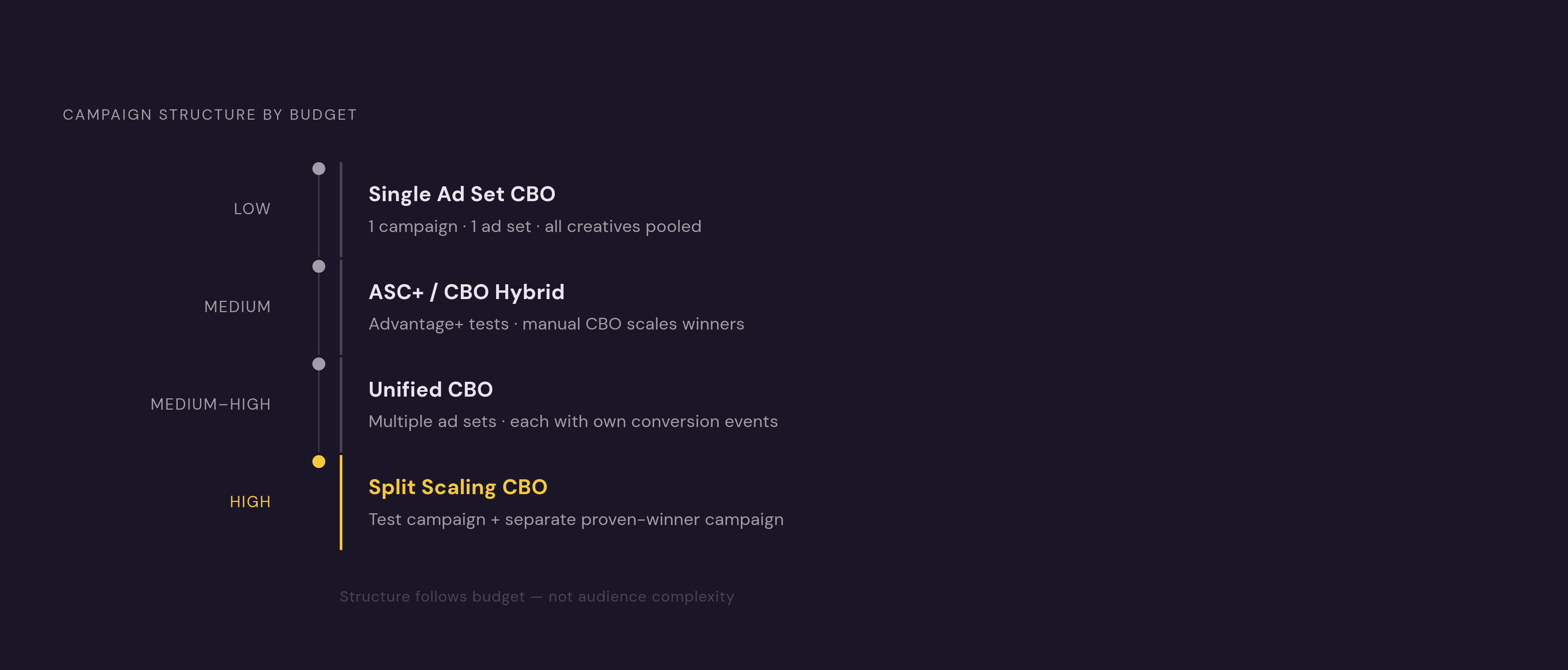
Low budgets and single-product brands fit a single ad set CBO structure, with one campaign, one ad set, and all creatives inside it. Every conversion then feeds the same learning pool. This is the simplest workable starting point.
Medium budgets that need offer testing fit an ASC+ CBO hybrid. An Advantage+ Sales campaign handles testing and broad discovery, while a manual CBO campaign scales proven winners. The separation gives each campaign a distinct job. It is justified only when the budget can support both.
A medium-to-high budget for a single product suits a unified CBO campaign with several ad sets, each with a large pool of varied creatives. The budget is still shared across the campaign, but each ad set needs enough events of its own to learn. With high budgets, split scaling CBO can be a better fit. That structure uses one campaign for continued testing and a fresh campaign for proven winners when engagement noise in a shared campaign starves those winners of spend.
The adlibrary.com best practices guide gives a working maximum of two to four active campaigns, covering main prospecting or Advantage+ Shopping, creative testing, retargeting, and an optional brand or category carve-out. The deepclick.com guide gives a practical range of two to four ad sets for most accounts, provided each has a genuinely distinct job. Neither range overrides the budget arithmetic.
Meta’s preference for lower cost per acquisition can let a cheaper product crowd out a higher-value one. Use a separate CBO campaign per product or average-order-value band.
CBO versus ABO and when each is the right tool
Campaign budget optimization, or CBO, has one budget for the campaign and lets Meta share it among active ad sets. Ad set budget optimization, or ABO, assigns a fixed budget to each ad set. The choice is about who controls allocation. CBO lets the system follow efficient conversions, while ABO protects spending that a human has decided must happen.
CBO is the default for consolidated structures when the ad sets have comparable potential and the goal is to let Meta find the winner. That lets Andromeda handle delivery on its own, without a person having to defend each share of the budget. But CBO can concentrate nearly all spending in one ad set. Another ad set may get too few views to do its job.
ABO is the better fit for controlled creative tests that need comparable exposure and retargeting audiences that prospecting volume would otherwise starve. If an ad set must spend, use ABO or a minimum-spend rule within the campaign. The adlibrary.com guide makes neither option categorically superior. The goal, the number of ad sets, and which ones must spend decide the tool, but both still need enough events to learn.
Why creative variation has taken the place audience segmentation used to hold
Once the number of ad sets fits the budget, creative is the main way to improve results within that structure. Different hooks, formats, and angles give Meta more ways to connect an ad with a likely buyer. Put that variation inside the ad set. Splitting every angle into its own ad set creates more learning pools when the goal is more delivery paths within the existing pool.
Creative fatigue then becomes a recurring constraint. Static creative pools exhaust within roughly two to three weeks, so the working cadence is four to six new creatives each week. At least one should introduce a genuinely new hook archetype or format. The distinction is between variety the system can use and cosmetic changes that leave the underlying idea untouched.
Advantage+ Creative adds variety through text variants, crops for each placement, changes to images, and image expansion. In 2026, it added AI dubbing, AI-generated music, and persona-based image generation. Automated variations do not remove the need to choose which ideas deserve testing.
More creatives in one ad set can make results harder to read, but separate ad sets buy that readability at the cost of fragmented learning. Use creative naming conventions. A review each week should find the creatives that work best, record test results, and plan which creatives to make for the next week.
Signal quality upstream of structure: the Conversions API and clean event data
Pooling conversion events only helps when they show what really happened. Browser-side Pixel tracking alone underreports conversions after iOS 14, leaving Meta with an incomplete picture of purchases. A cleaner layout cannot repair missing evidence. An account with 12 ad sets and Pixel-only tracking has both fragmented signals and data loss.
Install the Conversions API, or CAPI, alongside the Pixel. CAPI sends server-side events to fill in what browser tracking misses. It is free through integrations with major e-commerce platforms. That makes event quality a prerequisite check before judging whether a structural change worked.
In Events Manager, Event Match Quality should read 7 or above out of 10. Below 6, customer-information parameters are not being passed adequately and matching degrades. Deduplication between Pixel and CAPI events should also be strong so that using both does not double-count conversions. Consistent names that encode the tested variable, such as audience type, creative hook, or placement, then keep the consolidated account readable when results shift.
When to split and when to consolidate: the decision rules that govern both directions
Before adding an ad set, ask whether it will do a genuinely different job. Prospecting and retargeting can justify separation because intent, frequency dynamics, and creative needs differ. Geography can justify it when markets have meaningfully different CPMs, shipping costs, legal constraints, or languages. Those differences change the cost of delivery as well as the labels in reports.
Next, ask whether sharing the budget would work against the business goal. Different average-order-value bands need protection from the lower-CPA bias already described. A controlled creative test may also need equal ABO budgets so that an early leader does not absorb the spending. In both cases, the split protects a requirement that automatic allocation would not necessarily respect.
Then ask whether the planned split changes anything besides how the account looks. Interest-stack variations for the same buyer create overlap and auction competition, while creative-angle splits divide signals that belong together. An internal team boundary is no stronger a reason. The delivery system does not need to mirror an org chart.
Poor performance alone is not a split trigger. Duplicating into a new ad set or account discards history and restarts learning without fixing the underlying cause. That differs from a deliberate scaling move in which a winning ad set is duplicated at a new budget while the original keeps running. The other scaling route is incremental daily budget increases well below the threshold that resets learning.
Account structure therefore needs a defined audit cadence. The adlibrary.com best practices guide recommends a competitor structure audit before touching Ads Manager. Active competitor ad patterns provide a baseline for whether a planned split is unusual or standard for the category. That comparison gives structural review a reference point before either a person or an agent starts making changes.
How AI agents and Meta's MCP server change structural management without changing structural principles
Meta opened its advertising stack to external AI agents through an official MCP, or Model Context Protocol, server on April 29, 2026. The server at mcp.facebook.com/ads made external assistants OAuth-gated, first-party clients with read and write access to ad accounts. This changes who can execute account decisions. It does not change how many conversion events an ad set needs.
Meta announced a further step at Advertising Week New York on October 6, 2026. Its AI business assistant would start testing agentic features inside Ads Manager, and its ads MCP server now saved agent-built campaigns as drafts before they went live. The distinction between a draft and a live campaign is important here. Building a structure faster does not make it a good one.
AdManage.ai, Birch, Blip, Databricks, Innovid, Kochava, Perplexity, Reportei, Snowflake, and Triple Whale have built the server into their products. Their roles range from reporting and analytics to campaign execution. That range means integration alone is not a complete description of what a platform does. For structural management, the useful connection is between account information and the ability to execute the decisions drawn from it.
Clean signals and clear campaign roles give agents a stable account to operate on. Fragmented accounts instead present ambiguous states that automation has no mechanism to resolve simply by working faster. The practical next step is to connect AI execution to a structure whose budget, event data, and creative pipeline already make sense.