Meta Advantage Plus Shopping Campaigns for Startup Brands
Automation requires conversion history; here's how startups know if they're ready.

Meta’s automated shopping campaigns for startup brands are now sales campaigns, and they reward better inputs. Startups get the most from them by concentrating purchase signals, supplying varied creative and excluding existing customers from acquisition. But automation is a scaling tool that requires conversion history. The right setup starts with knowing whether the brand is ready.
What Advantage+ Shopping Campaigns (now Advantage+ Sales) actually are in 2026
Advantage+ Sales has taken the place of Meta’s Advantage+ Shopping Campaigns. The current structure has automated audience selection and budget allocation, along with campaign-level budget controls, ad set exclusions and product set optimization. Advertisers still decide where they can fulfill orders and which customers to exclude. That is not the old black box. Guides based on the original ASC structure leave out controls that now affect delivery.
Underneath it sits Meta’s Andromeda retrieval engine. It can hold roughly 10,000 times more ad variants in parallel than the previous system, scoring the creative library against each user’s signals at auction time. It selects the product and creative together. Instead of choosing an audience segment and hoping the right product appears, the advertiser supplies material the engine can match to buyers.
In its March 2026 updates, Meta added consolidated budget controls, a buy-now button in ads, creator commissions on Instagram and product set optimization. The automation layer also expanded during this transition. The primary Manus AI integration launched in February 2026, followed by Manus AI connectors for Ads Manager in beta on March 18. These additions broaden the operating tools without removing the advertiser’s responsibility for the inputs.
Why the algorithm rewards signal consolidation and punishes fragmented account structures
When a startup divides limited conversions across many campaigns and ad sets, each has less information for judging which ads deserve budget. Consolidation puts more evidence behind the same allocation decisions. A simpler account gives the algorithm more chances to link its delivery choices to what people buy.
That advantage compounds as campaigns leave learning faster and spend less on under-powered ad sets. With enough evidence in one pool, the system can also find audience pockets the advertiser would not have selected manually. Tight targeting can stop the system from finding those people in the first place. Building the structure around who the founder thinks will buy may keep automation from finding other buyers.
However, manual campaigns with tighter targeting have outperformed ASC at lower daily budget tiers in tracked scenarios. That objection deserves a straight answer. An algorithm with too little signal or budget cannot explore efficiently simply because the account is consolidated. This is a readiness problem. The next decision is whether to switch at all.
The readiness threshold startup brands must clear before switching to Advantage+ Sales
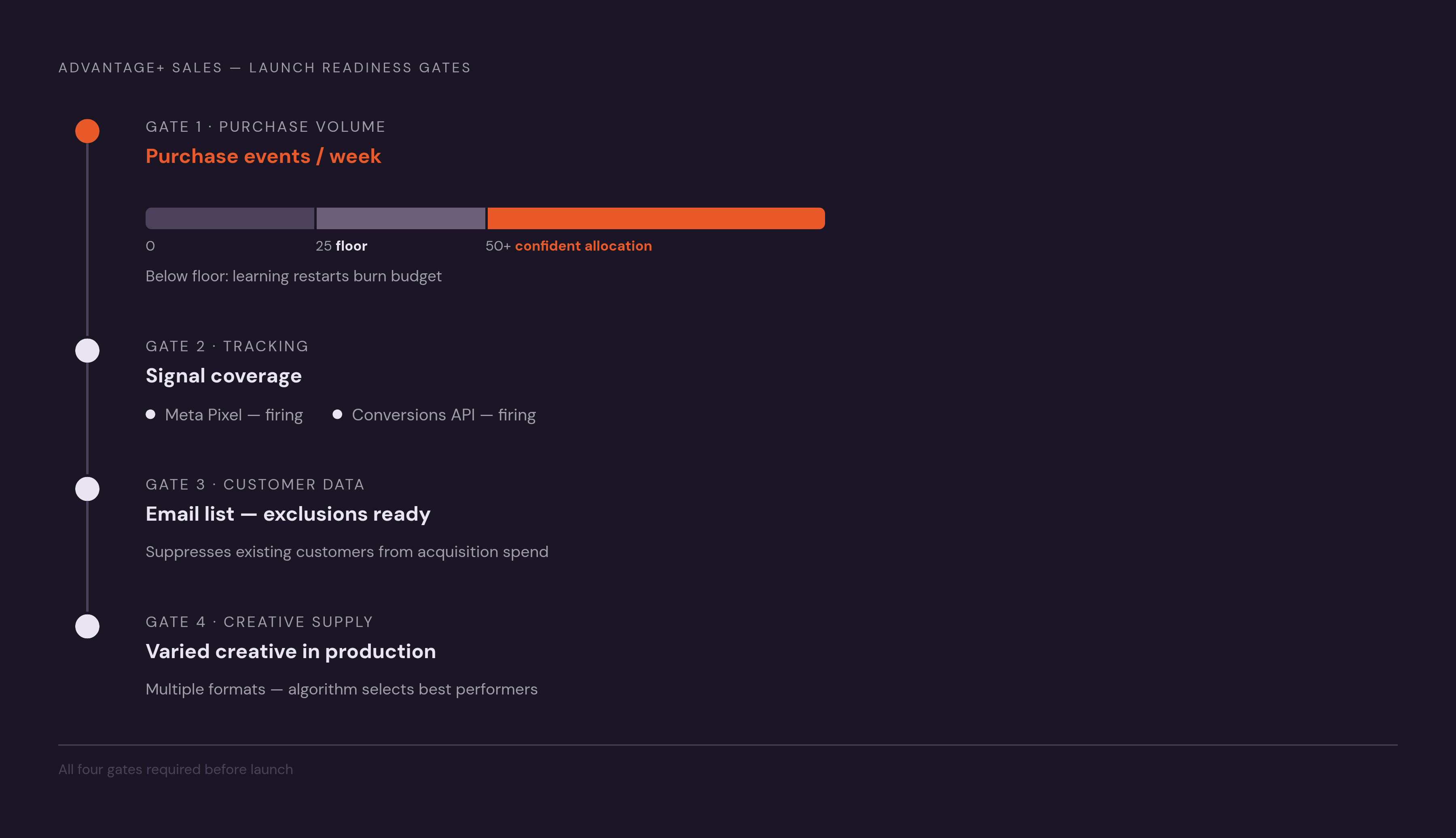
A startup should judge readiness by purchase activity, tracking quality, customer data and creative supply. Meta’s April 2026 minimum is at least 25 purchase events per week, with performance improving meaningfully above 50. Below the minimum, repeated learning restarts burn budget without confident allocation. Automation cannot manufacture the evidence it needs. A brand that is still building its purchase history should run a standard purchase-optimization campaign before it switches.
Tracking is a separate gate to clear before launch. Pixel-only tracking captures only part of the conversion picture, while server-side Conversions API tracking recovers a substantial share of what it misses. Strong Event Match Quality is associated with lower CPAs than weak match quality on the same budget. Purchase volume alone is therefore not enough. The events also need to reach Meta in a usable form.
For a founder checking readiness today, the remaining questions are practical. Are the pixel and Conversions API installed and firing correctly, is customer email data accumulating for exclusions, and is varied creative already in production? Those inputs take preparation, even when campaign creation is quick. A brand missing them should build them before launch rather than pay for the algorithm to work around their absence.
How to structure an Advantage+ Sales campaign correctly at the startup scale
Once the brand is ready, the setup should follow the signal. Before creating the campaign, connect the product catalog and verify that the pixel and Conversions API send purchase events correctly. Then select the Sales objective in Ads Manager and choose the Advantage+ campaign type. Give the daily budget enough room for learning. A campaign starved of spend cannot turn consolidation into useful exploration.
Next, set geographic targeting around where the brand can fulfill orders. Audience suggestions can provide relevant demographic guidance, but they do not restrict delivery. The distinction is especially important when thinking about age floors for alcohol or other regulated categories.
Existing customers need a different control. Upload the customer email list as a Custom Audience and exclude it at the ad set level. The old campaign-level existing-customer budget cap has been removed from Advantage+ Sales, so legacy instructions pointing to it are wrong for this structure. A home goods brand saw substantially lower CPA and a significantly higher new customer acquisition rate after consolidation, diverse creative and the former customer cap. The current suppression mechanism is the ad set exclusion.
Finally, use product set optimization to connect specific SKU collections to product launches and seasonal pushes. This March 2026 feature gives promotional timing a place in the campaign structure. The algorithm can then deliver from a product set aligned with what the brand is promoting.
Why creative variety is now the primary performance lever, and what that means practically
With audience selection and budget allocation automated, creative becomes the main performance lever left in the advertiser’s hands. The engine matches people to ads, so a thin library limits the matches it can make. Changing targeting cannot add a message that is missing from the ads. What looks like a bidding problem may instead be a creative bottleneck.
UGC video, product demos, testimonials, static product shots and carousels give the system different creative signals to work with. Different opening seconds can speak to emotional or functional triggers, while price anchoring, social proof and problem/solution messages test different reasons to buy. An ad needs to give someone a different reason to pay attention, beyond a new visual treatment.
UGC outperforms branded creative on CTR and CPA in the supplied performance findings, reaching audiences that respond to authenticity more efficiently. Brands testing more new ads monthly achieve meaningfully higher ROAS than those testing fewer, making creative testing velocity a stronger performance predictor than audience setup or bidding configuration. A fashion DTC brand substantially improved ROAS within weeks of moving four campaigns into one ASC campaign. Its diverse creative library gave consolidation something to work with.
How to read Advantage+ Sales performance correctly and avoid the new-customer trap
Reported return on ad spend can make acquisition look healthier than it is. Advantage+ Sales tends to chase cheap, last-click conversions from people who are already close to buying. That behavior fits its conversion goal, but it does not necessarily bring the startup new customers. A cheap purchase is not necessarily new growth. Without customer suppression, money meant to bring in new customers can go to people who are already likely to return.
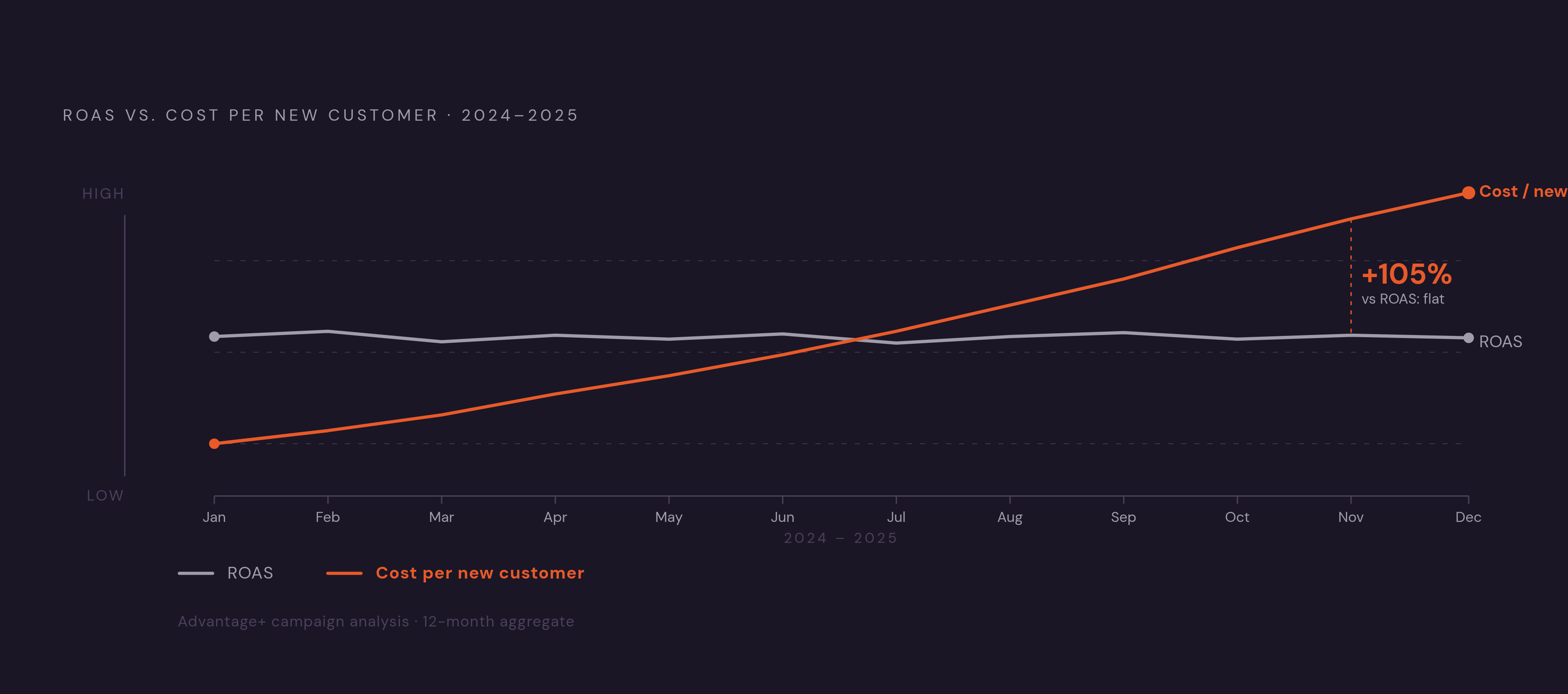
The gap can be large even when the dashboard looks steady. A large-scale analysis of Advantage+ campaigns found that cost per new customer rose 105% over a 12-month period between 2024 and 2025 while ROAS appeared stable. The two metrics were answering different questions. ROAS described attributed sales efficiency, while cost per new customer exposed worsening acquisition economics.
The measurement response is to track cost per new customer alongside cost per purchase. Where existing-customer retargeting is also a goal, it belongs in a separate ad set with its own budget cap so its results can be measured independently. Lead or acquisition campaigns should also be judged on qualified conversions, with lead quality checked in a CRM. Incrementality testing becomes more important as automation takes over delivery. Meta’s AI optimizes for Meta’s reported conversion signal.
How tracking quality determines how much of the campaign's learning the algorithm can actually use
Conversion tracking is infrastructure. Even with a strong creative library and a sound structure, the campaign still suffers when the algorithm gets no purchase information or cannot match what it gets. Changes to iOS and ad blockers can hurt browser-only tracking, and the signal gets weaker still when customer fields are missing or event parameters are wrong. Events that fire on the wrong page also weaken the signal.
To put that infrastructure in place, install both the Meta Pixel and the server-side Conversions API before launch. In Events Manager, verify purchase, add-to-cart and initiate-checkout events at minimum. Pass as many customer data fields as possible with each event, including email, phone and name, to strengthen matching. Then check for duplicate browser and server events. Use the event ID parameter to deduplicate the same action.
How to scale Advantage+ Sales spend without resetting the learning phase
Scaling works best when the campaign can extend what it has learned. Daily budget increases should come in increments, because large sudden jumps can effectively restart learning. The goal is more spend without abrupt disruption. Changing the campaign objective or conversion event, or pausing and reactivating campaigns after extended periods, can also trigger a restart.
Adding new ads to an existing ad set does not restart the learning phase, while pausing and replacing existing ads can disturb it. Adding ads regularly helps with creative fatigue without replacing all the ads at once. That distinction makes a continuing supply of new material the basis of a startup’s production planning.
The fashion brand also scaled spend significantly while maintaining ROAS by keeping its campaign structure stable and adding creative volume. The brand changed what the algorithm could show while preserving the structure in which it learned.
That does not make manual prospecting obsolete. One to two manual prospecting campaigns can complement Advantage+ Sales, with the budget split determined by performance data. They can test new audiences or messaging hypotheses that later inform creative additions to the automated campaign. The choice is not all manual or all automated.
Where AI tools and MCP agents fit into running Advantage+ Sales without a full agency team
Automation does not remove the daily work around a campaign. A small team still has to check performance, refresh creative, keep exclusion lists up to date and write reports. Tooling becomes useful when it takes routine handling out of that workload. The brand’s growth objective still has to distinguish new customer acquisition from inexpensive repeat purchases.
Meta launched Ads AI Connectors in open beta in April 2026, giving access to ad-platform APIs through an MCP server and a companion command-line interface. These interfaces cover reporting, campaign management, catalog management and signal diagnostics. An AI agent connected through MCP can check performance, pause low-ROAS ad sets, shift budget and produce a summary in a fraction of the time manual clicking requires. The operator gives instructions in ordinary language. The operator can see and approve every proposed change before it takes effect.
For a startup, that approval step connects faster operation to the discipline already required for scaling. A proposed budget shift still needs to avoid a disruptive jump, and a performance summary still needs to distinguish ROAS from new customer economics. Faster execution does not make the wrong metric right. AI tools help a small team do more when they handle routine work within those limits, while people stay in charge of creative direction, acquisition goals and the decisions automation should leave to them.