Facebook Ads Library API for Competitive Creative Research
The API covers less than expected, so durability becomes the proxy.

The Facebook Ads Library API can turn Meta’s transparency archive into a competitive creative research engine, but it is not a universal ad archive. How useful it is depends on what it covers, how carefully performance proxies are used, and how ad records are turned into creative briefs. Getting the data is only the start.
What the Facebook Ads Library API actually covers, and what it does not
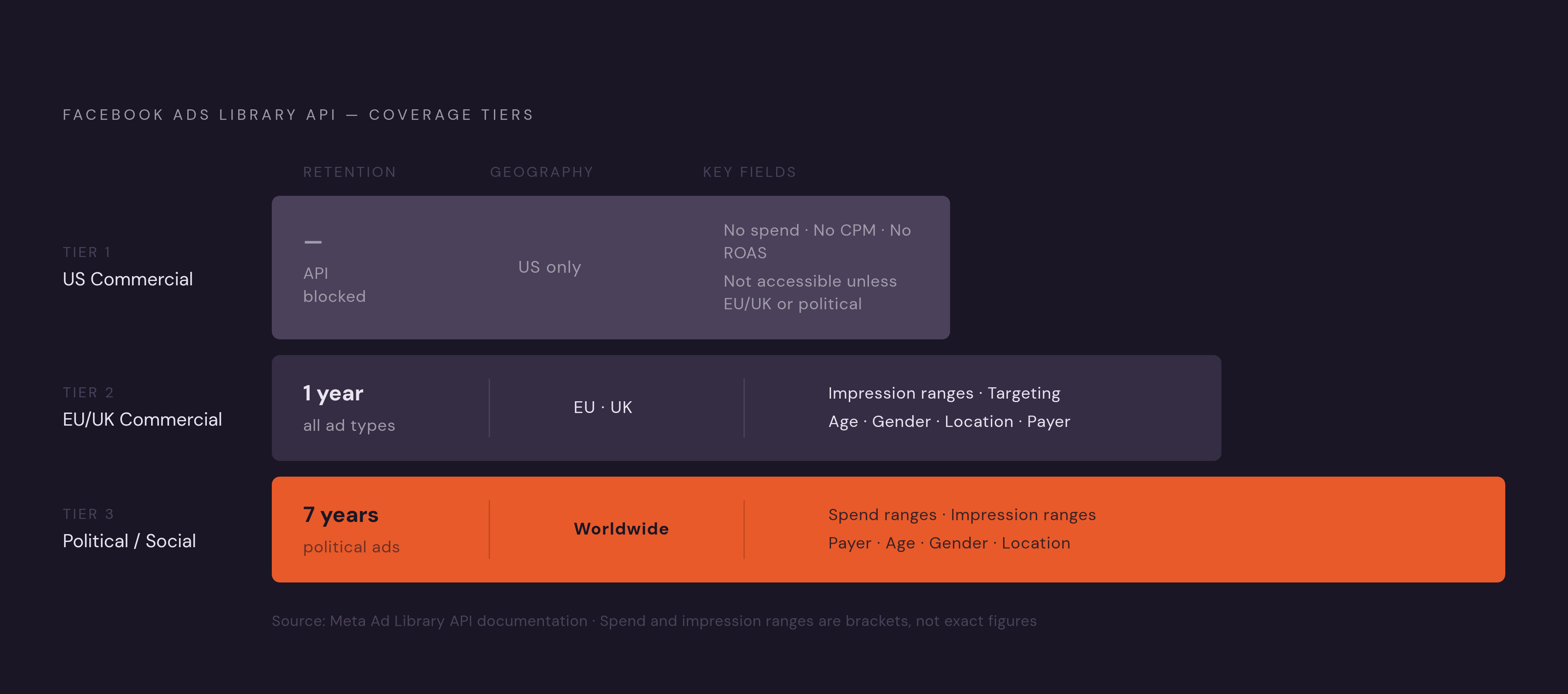
A standard commercial ad shown only in the US does not appear in the API unless it also ran in Europe or was classified as political. That rules out a large part of what commercial researchers expect to retrieve. The public interface can show active commercial ads outside the UK and EU, but the API does not make them available as a queryable archive. An ad visible in the browser is not necessarily accessible through the endpoint.
Geography therefore defines the commercial research boundary. All ad types delivered to users in the UK or EU are archived for a year, making this tier useful for studying both current and past commercial creative. Political and social-issue ads are covered worldwide and stay in the archive for seven years. They also have the most data disclosed, including spend ranges and details about the payer. These are separate coverage tiers.
Meta positions the API as a transparency tool for researchers, journalists, and organizations studying advertising transparency. That transparency purpose shapes both the records available and the application gate that controls access.
What data fields the API returns for each coverage tier
Every archived ad includes a Library ID, creative content such as copy and image or video assets, and the advertiser’s Page name and Page ID. Delivery fields include ad_delivery_start_time and, where available, ad_delivery_stop_time. Active status and platform placements provide further context. The placement fields cover Facebook, Instagram, Messenger, Audience Network, WhatsApp, Oculus, Threads, and Streaming Services. Together, these fields establish what ran, who ran it, and its delivery window.
The richer fields depend on the coverage tier. Political and social-issue ads add bracketed spend and impression ranges, reach by age, gender, and location, and payer or disclaimer information. Ads delivered in the UK/EU also have estimated impressions in tighter ranges, targeting parameters, reach demographics, and details about the advertiser and payer. Those impression ranges let researchers distinguish an ad that merely remained available from one that reached a substantial audience. They give longevity a useful second test.
Missing values in a null field can reflect coverage rules. Commercial ads do not gain spend, budget, CPM, CPC, CTR, conversions, or ROAS simply because they appear in the European archive. The pipeline has to preserve that distinction.
How to get API access, and where the application gate stops most commercial users
To get official access, applicants must first verify their identity through Meta. The setup then requires a developer app in Meta’s developer console, an access token, and calls to the ads_archive endpoint with the relevant filters. The procedure is straightforward, but eligibility is not automatic. The research-purpose restriction still applies once an app has been created.
Meta allows access for verified political and issue-ad transparency research around the world, as well as research on all ad types delivered in the EU/UK. Applications framed around commercial brand monitoring, including competitor creative, landing-page tracking, or spend analysis, will be rejected under that gate. This is the main obstacle for commercial users. The access process reflects the archive’s transparency purpose rather than the broader demand for competitor research.
For eligible applicants, the API supports up to ten Page IDs in a single call, while the native interface handles one advertiser at a time. That difference makes repeated competitive scans practical. The limit of 200 queries per hour per app is enough for daily scans, but large exports still need pagination logic. Access approval and export capacity are separate constraints, and a bulk pipeline has to account for both.
Why most competitive intelligence pipelines use scrapers instead of the official API
Third-party scrapers fill the gap between commercial demand and official API access. They fetch the library results shown in the browser and return structured records without the same identity-verification process for commercial use. Some support bulk exports beyond the official ten-Page-ID query limit, normalize fields into JSON or CSV, and download creative assets. Others add EU-reach fields or Claude/MCP connector support. This layer is a structural response to the access restriction.
The legal position is still grey, and permission is still a concern. Meta’s terms technically disallow scraping, including workflows built around query URLs and rendered results. Nor does scraper access create performance fields that Meta never disclosed.
Named options include AdSpends, Curious Coder (Apify), and ScrapeCreators, but the notes do not establish one universal winner. Evaluation criteria include price per 1,000 EU-reach ads, returned fields, reliability, and Claude/MCP agent support. EU-reach pricing varies substantially across providers, so the price comparison needs to use the same kind of record. For an agent-driven research pipeline, connector support is a separate buying criterion from data coverage.
Ad durability as the primary performance proxy when spend data is absent
Once records are available, the problem shifts from retrieval to interpretation. When commercial spend or conversion data is missing, ad durability is a main performance proxy. The reasoning is simple but imperfect. Advertisers tend to pause losing ads and keep useful ones running, so surviving creative deserves closer inspection. That does not make survival proof of profit.
Durability is calculated by comparing ad_delivery_start_time with the current date for an active ad. Filters for 30, 60, or 90+ days isolate cohorts that have stayed live beyond a short test. Illustrative patterns show what this analysis can surface. A Vuori-style pattern would be a large share of long-running ads using comfort-first language, relaxed non-athletic positioning, and little technical detail, despite frequent new launches. A Ridge Wallet-style pattern would keep the copy the same while changing visuals, influencers, and contexts, so copy is the control and imagery is the test variable.
Under cost-cap and bid-cap buying, an old ad may have had little delivery, with little spent on it over time. Impression weight gives a clearer view of how many people an ad actually reached. Use durability to find candidates, then use available impression ranges to test their scale. Neither filter shows CTR, conversion rate, profitability, or whether the advertiser thinks the ad did well.
Creative velocity as a competitive signal the API surface makes readable
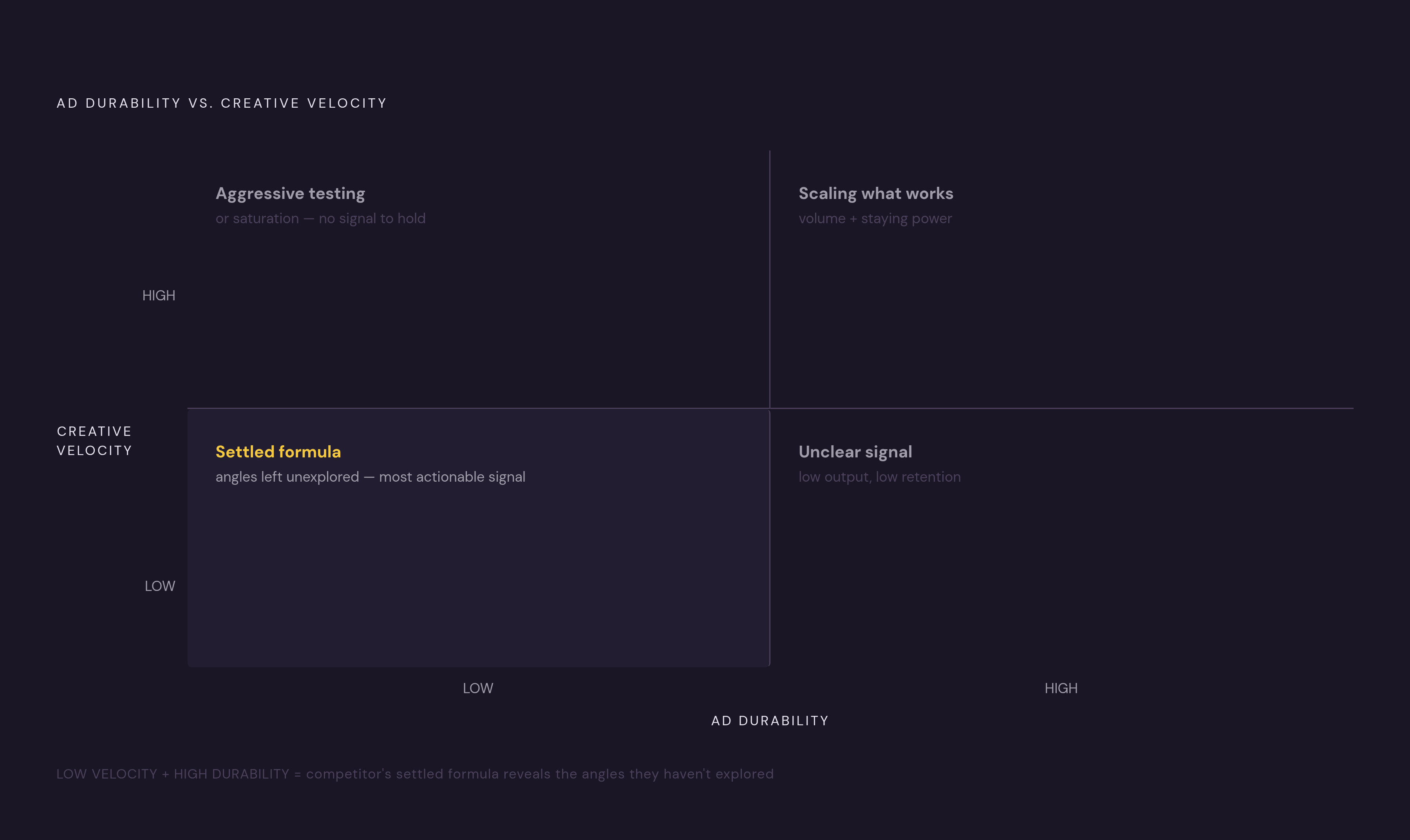
Durability shows what survives, while creative velocity shows how quickly an advertiser launches new work. Reading them together gives a more useful picture than either measure alone. High velocity with low durability can suggest aggressive testing or saturation. Low velocity with high durability can suggest a settled formula and an opening to differentiate on angles the competitor has left behind. These are interpretations to investigate.
Velocity requires a record of change over time. The native interface does not show a launch-rate trend, and a single API response cannot establish one. Daily archiving means storing the JSON response with a timestamp so that successive snapshots can be compared. That history makes launch rate computable. Without it, a large current inventory can be mistaken for a sudden burst of production.
Rising velocity within a product category or keyword cluster can also point to forming demand before it appears in mainstream data. Grouping new ads by message and format makes the signal more useful: language clustering can show how ads differ in their emotional frames and main angles, while visual tagging sorts user-generated content from work made in a studio. Those layers connect a change in output to a change in creative direction.
Where the EU/UK data layer unlocks targeting intelligence unavailable anywhere else in the API
The UK/EU tier introduced earlier is more than a coverage exception. For commercial research, it is the route to targeting and reach information that the standard commercial view does not provide. An EU-country search can reveal paused ads, delivery windows, and reach numbers for a competitor selling in France, Germany, Ireland, or another EU market. The US-country view does not expose the same archive for that brand. Country selection changes the evidence available.
The archive includes inactive ads for up to a year after their last impression. It also provides demographic splits for the reached audience, including age and gender, plus targeting parameters and tighter impression ranges. Targeting and reached demographics serve different analytical purposes. The former describes delivery parameters, while the latter describes the audience reached.
Meta must disclose this information for EU-delivered ads under the Digital Services Act, and the same archive has been extended to the UK. For practitioners, the resulting workflow is concrete. A competitor audit should run each query for the primary market and again from an EU country when the competitor also sells in Europe. This makes the geographic tier an active research tool rather than a limitation discovered after an incomplete export.
The gap between ad records and an actionable creative brief, and how to close it
A JSON response full of durable ads is still not a creative brief. It contains assets and copy. Durability and impression ranges help select candidates, but they do not explain why an ad works. A usable brief needs a claim, a target emotion, a reason for the chosen format, and a differentiation angle. None is a field returned by the API.
Natural-language clustering can group emotional frames such as aspiration, fear, social proof, and urgency. Semantic analysis can identify the problem each ad presents and how it frames the solution. Visual classification then separates user-generated from studio content and lo-fi from polished production. This keeps production style distinct from the message it delivers.
Landing-page analysis adds the next piece of context. It asks whether the destination delivers on the ad’s promise, rather than treating the creative as an isolated asset. Message match correlates with durability, and lo-fi work can outlast polished production, but neither observation establishes the cause of performance for an individual ad. The brief must keep that uncertainty visible.
The useful output moves beyond an inventory of competitor ads. It identifies, for example, a durable cohort built around social proof, user-generated content, and comfort-first language, then names an angle that the competitor has not scaled. That is a direction for original work.
What the API cannot give you, and where multi-channel intelligence fills the remainder
The API restricts disclosure of commercial spend, budget, CPM, CPC, CTR, conversions, or ROAS to the political disclosure tier. It also provides no archive of paused US-only commercial campaigns and no view of a competitor’s activity across Google, TikTok, LinkedIn, or YouTube. European coverage improves Meta research, but it does not turn Meta records into a complete advertising picture.
PowerAdSpy indexes creative across Facebook, Instagram, TikTok, YouTube, Google, Google Display Network, native, Reddit, Quora, Pinterest, and LinkedIn, with placement, targeting, and engagement filters. Pathmatics by Sensor Tower covers social, display, video, mobile, OTT/CTV, retail media, and linear TV. Its offering includes competitor spend estimates, impressions, share of voice, channel mix, audience targeting, and seasonal investment trends. These estimates still differ from results shared from an advertiser’s account. These tools broaden the evidence rather than filling hidden fields in Meta’s API.
To start for free, teams can use the Meta Ad Library, TikTok Creative Center, and Google Ads Transparency Center together to look at active creative from competitors they already know. Paid tools become necessary for historical archives of paused ads, cross-niche keyword discovery, or team swipe-file workflows at scale. The practical division is clear. Use the API for covered Meta records, use other sources for cross-channel activity and estimates, and build the analysis that converts those records into a creative brief. That translation is the real engineering challenge.