Wiring Meta Ads MCP Into a Retainer Workflow for Automated Reporting and Budget Pacing
Meta's new MCP supplies the tools, so you supply schedules and spending limits.

Meta Ads MCP lets an AI assistant use Meta advertising accounts through an official, OAuth-gated server that has tools for reporting, campaign management, and diagnostics. For a standing retainer, it provides the data and actions, but not the scheduler or approval policy. Automated reporting and budget pacing become practical when scheduled triggers run the work and humans control the spending boundaries.
What Meta shipped on April 29, 2026, and why it changes the retainer model
Meta launched its official MCP server at mcp.facebook.com/ads on April 29, 2026, making an AI agent a sanctioned, first-party client of a Meta ad account. Read and write access arrived together. Its 29 tools expose real Marketing API operations, including the ads_* operations that agent platforms already wrap.
The authentication path changed with the tools. Before this, connecting meant registering a Developer App and waiting days for App Review. The new path uses a single Meta Business OAuth dialog to grant per-user access across accounts in a selected Business Manager portfolio in minutes. There are no long-lived tokens to store or rotate.
The 29 tools, grouped by what a retainer workflow actually uses
The useful way to read the inventory is by job. Insights and benchmarks serve scheduled reporting pulls and period comparisons. The accounts, pages, and assets area provides three tools for ad account discovery, ad entities, and pages for business. That discovery layer comes first because the agent needs to identify the account and its assets before reading performance or changing anything.
Campaign management provides five tools, namely ads_create_campaign, ads_create_ad_set, ads_create_ad, ads_update_entity, and ads_activate_entity. They build and edit the campaign tree and change budgets or status. Every newly created entity lands paused. For pacing, the update tool is central, while activation introduces a separate approval boundary.
Dataset and tracking diagnostics provide four tools covering pixel health, Conversions API setup, event match quality, and signal anomalies. These support standing account-health checks. Product catalog tools cover catalog creation, diagnostics, feed rules, products, product sets, and feeds, making that area especially useful for commerce retainers with large SKU sets. Reporting, campaign writes, and diagnostics are the core retainer subset, while catalog work depends on the client. The server also gives the agent access to Meta Ad Library to search for competitors’ ads in the same workflow.
The structural limit every retainer operator needs to understand before wiring anything
MCP is a command-and-query interface. It responds only when prompted. If CPA spikes at 3 AM on a Friday and no one prompts Claude, the MCP alone does nothing. Tool access is not the same as autonomous operation.
The server does not supply timed rule execution across campaigns, persistent operational memory between sessions, or cross-platform budget reallocation. It also does not provide competitor auction visibility or broader category seasonality signals. The workflow should account for these missing pieces before the agent gets permission to write.
To turn the interface into a standing cadence, put a scheduled trigger in front of it, using a cron job, a CI pipeline, or a workflow tool. The trigger starts the task, and the agent uses MCP to query or act on the account. Without that layer, even a well-written pacing instruction remains something the assistant can follow only when invoked.
How to wire scheduled reporting into a standing retainer cadence
Reporting is the best place to start because it cuts the work of making reports while leaving spend decisions with people. Pulling data, formatting it, and building charts take most of the time spent on reports, leaving less time to make sense of the results. Start with an approved reporting period and a branded template. The agent’s job is to prepare the evidence and draft.
A reference cadence begins at 06:00 on the first working day of the reporting period. The scheduled trigger asks the agent to pull the approved period from Meta Ads and any other connected platforms. Validation comes next. The agent checks required fields, flags missing data, and confirms that the pull covers the agreed period before proceeding.
Once that check passes, the agent populates the template, compares approved periods, and drafts commentary under the agency’s rules. The commentary covers what changed, why it deserves attention, and what comes next. The strategist then receives the numbers, draft, and source links. This review is where the strategist replaces extraction work with judgment.
A human still sends the approved report, whether it is a PDF, email summary, or dashboard link. Google’s official MCP server is read-only, which gives clients a useful comparison when they ask why access does not let an agent send reports on its own. Databox connects Claude, ChatGPT, and n8n to business metrics, showing how reporting tools can work in this setup. A unified data, monitoring, and reporting interface can also avoid the sync delays and authentication upkeep of a stitched-together pipeline.
Wiring budget pacing guardrails so the agent moves spend without triggering the learning phase
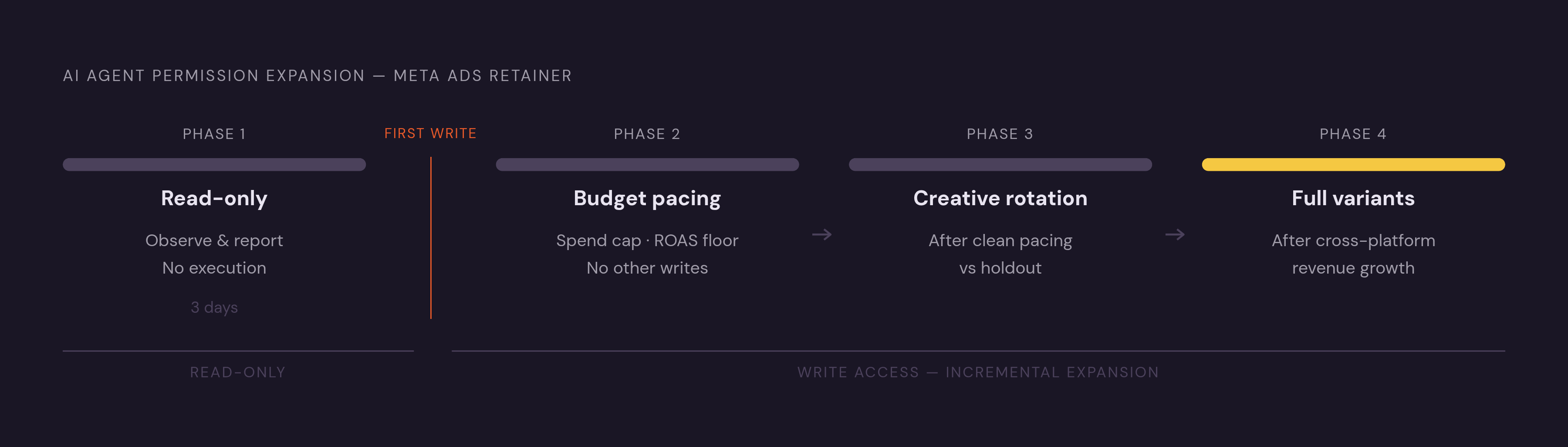
Pacing changes the risk because the agent starts writing. Manual pacing is error-prone and directly linked to recoverable revenue loss, so consistent increments offer a valuable automation target. Guardrails need to set limits on each move before the agent gets permission to make it.
The rollout starts with three days of read-only work. During that phase, the agent observes, reports anomalies, and proposes pacing actions without executing them. Phase 2 permits budget pacing within preset limits while all other writes remain blocked. Before that phase begins, set a daily spend cap, a per-ad cap, and a ROAS/MER floor. These boundaries apply even when the agent’s analysis recommends more spend.
Phase 3 adds creative rotation only once pacing behavior is clean against a holdout. Phase 4 adds full variant generation only after a cross-platform test shows that total revenue has grown. Within-campaign shifts between ad sets come first, with cross-campaign moves following clean holdout data. Moves between platforms still need approval until tests support them.
Learning-phase disruption is a reason to constrain budget changes, but there is no supported numeric threshold or recovery cost here to encode as a universal safe rule. A cap alone is not proof that an adjustment will avoid disruption. Although ads_activate_entity starts spending for new entities, ads_update_entity can resume an existing entity by setting its status to ACTIVE. A human must confirm that status change in every phase.
Where human approval authority must remain, and how to encode it in the agent's instructions
Meta’s paused-create default and confirmation before going live are a starting point for a client-budget policy that needs additional boundaries. The extra boundaries belong in the agent’s instruction file. Write activation control literally. “Never activate a campaign, ad set, or ad without explicit human confirmation. This includes setting an existing entity’s status to ACTIVE through ads_update_entity.”
Budget authority needs equally clear wording. “Treat daily budget, total spend, and campaign start time as human decisions. Prepare a reasoned proposal with supporting data, and let the human set the number. Execute pacing adjustments only within explicitly approved guardrails.” This separates delegated adjustment from permission to redefine the budget.
Account identity deserves its own permanent instruction. “Repeat the account name before every write operation.” An agency login may expose every ad account it can reach, so “set up the same thing” is not enough to identify the intended client. Even when the agent makes the right change, doing it in the wrong account leaves another client with the cost.
The remaining rules should be just as direct. “Every price in an ad must match the store’s current price. Spell out discount conditions, and require a human final read before activation.” For customer data, use “Leave hashed customer-list uploads to a human, with custom audience terms accepted in the account and an appropriate legal basis under applicable data regulations.” For destructive actions, use “Pause or archive rather than delete.” The production agent should not have delete permissions.
The multi-account problem and where third-party connectors still earn their place
Meta’s official server is the right default for a single-account in-house team. Its first-party authentication and direct access fit that job. An agency retainer spanning several clients and channels has a different requirement, however. Access to multiple Meta accounts is not the same as a consolidated operating view.
The choice therefore turns on three practical needs. When a retainer covers Google, LinkedIn, Reddit, and Meta, it needs more than Meta MCP to compare data across platforms. Connectors help agencies manage accounts when they bring many clients into one interface without making staff switch OAuth sessions by hand. Autonomous operation requires persistent rules and continuous monitoring loops that Meta’s server does not supply.
Those are reasons to add a connector alongside the official interface. A third-party layer earns its place when it supplies a missing operating function, such as cross-campaign reallocation without a human prompt. The comparison should stay concrete. Which accounts can it manage together, which platforms can it consolidate, and what runs when nobody is chatting with the assistant?
Using the Ad Library tool as a standing competitive intelligence layer in the retainer
The Ad Library query can run as part of the weekly reporting pull, with no need for a separate research project. The scheduled agent can search live competitor ads without a fresh human prompt or extra Ad Library tooling. Append a competitive snapshot to the report. It can show new ads, ads that have been running for a long time, and ads that have gone dark.
That snapshot becomes more useful when paired with account data. If client frequency is rising while competitors rotate new creative, the agent can flag the combination and recommend a refresh before ROAS degrades. A CPM spike also reads differently when three major competitors launch campaigns in the same window. This adds context without proving causation.
Reports to clients need careful wording because seeing competitors’ ads does not show how much they spend. Reading long-running ads as a signal of proven performance is an unverified interpretation. The snapshot should not turn into a spending estimate or a claim about competitors’ auction positions. Its value is a better-informed discussion of creative and market activity.
What the MCP-wired retainer workflow actually changes for the people running it
Daily account checks that took roughly 20 minutes compress to a fraction of that time, and weekly reports that took the better part of an hour shrink similarly. At small and mid-size agencies, checks, reports, and first-pass audits that filled a junior media buyer’s week can compress into a few hours. That opens room for strategy, creative direction, client management, or more accounts.
The client relationship changes only if the team uses the time it saves to make better judgments. The strategist still has to explain which changes deserve action, which need more evidence, and which fall outside the agreed scope. Human review is therefore part of the service.
That approval architecture is also a selling point. Clients can understand a division in which agents read and synthesize while people approve and send. The retainer does not need an irreversible leap into full automation to become more productive.