Setting Bid Guardrails Before You Give an LLM Agent Write Access to Google Ads
Bid caps, approval gates, and scoped roles keep agents in check.
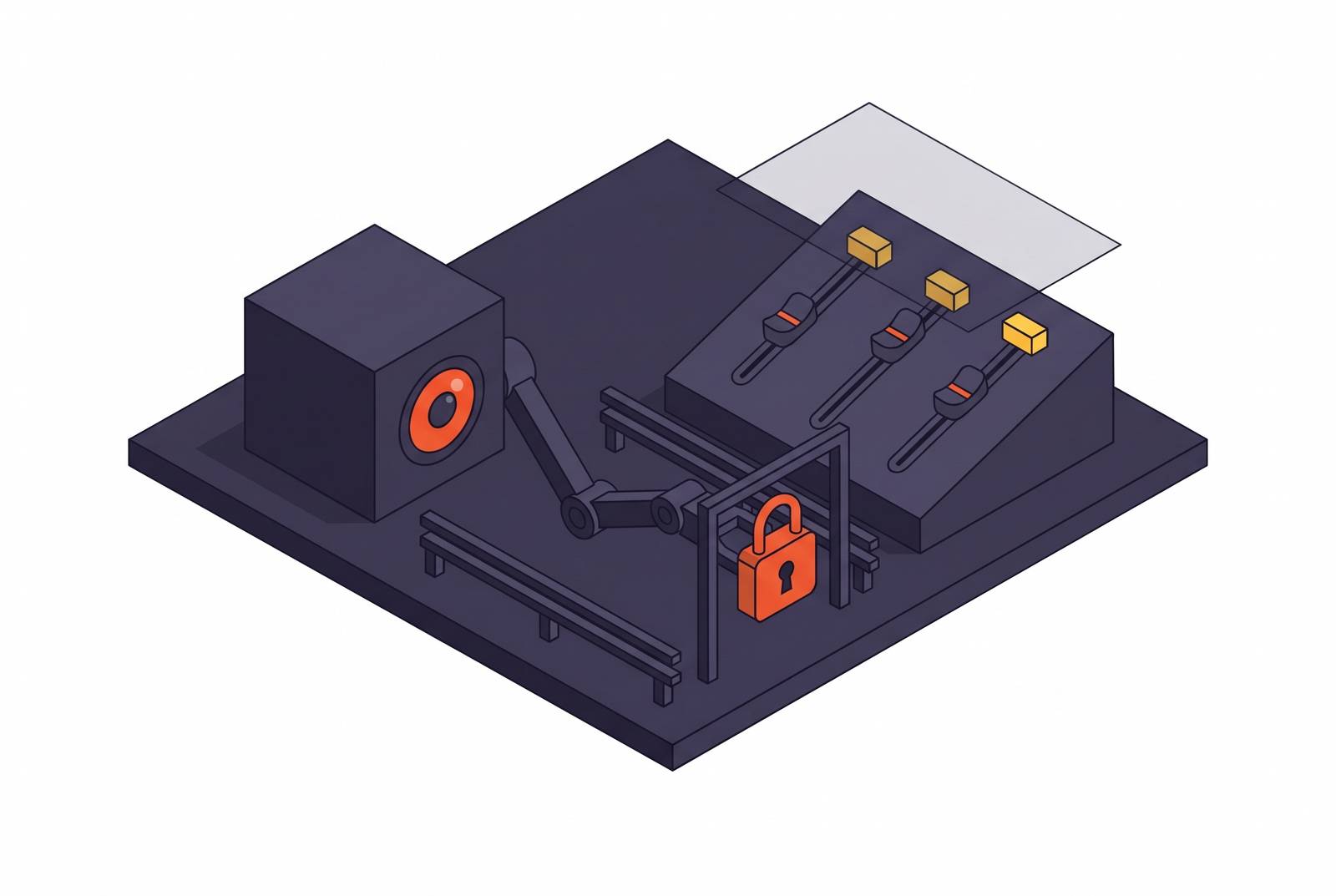
Google Ads MCP connects AI assistants to Google Ads tools, but write access depends on the server and the account’s permissions. Google’s official server has few write tools, while third-party servers can let agents change bids and budgets and use campaign controls. Before granting an LLM agent that access, teams need explicit bid limits, human approval gates, scoped permissions, and a queryable change log. A connection is not a safety system.
Why write access to Google Ads is a categorically different risk than read access
An agent with read access is an analyst. It can surface insights quickly, but a human still decides what reaches the account. Write access takes away that delay, so changes can happen often without someone doing the work by hand each time. It also turns a mistaken recommendation into a live spend event. Errors can compound before anyone notices.
The failure can start with something small. An agent that confuses CPA with ROAS may pause a strong campaign, while an instruction to pause low-CTR campaigns may catch brand defense that is performing its intended role. A hallucinated budget figure can double a daily budget, and Google’s overdelivery policy allows spending up to twice the average daily budget on a single day. Malicious instructions hidden in an ad description or other external data are another way to get the agent to take unwanted action. Speed and autonomy are assets only inside a well-specified operating envelope.
Can teams rely on the official Google Ads MCP boundary alone?
Google’s official server takes a narrower approach than third-party servers that expose budget changes, bid changes, and campaign pause or enable operations. That distinction is useful when choosing an integration for Claude or Cursor, but the assistant’s name does not define its reach. The connected server and Google account role do. Teams using a different server or the API directly do not inherit the official server’s restrictions.
The token is not a read-only guarantee. Google’s OAuth documentation specifies a single adwords scope, with no read-only variant, so enforcement depends on server code and account permissions. The MCP specification also treats readOnlyHint as an annotation. Even the official server’s propose-and-confirm flow, which validates a request, returns a checksum, and requires another call, is not proof of human consent. A model can make the confirming call itself, so teams still need controls they own.
What operations to allow, restrict, and prohibit before any agent touches the account
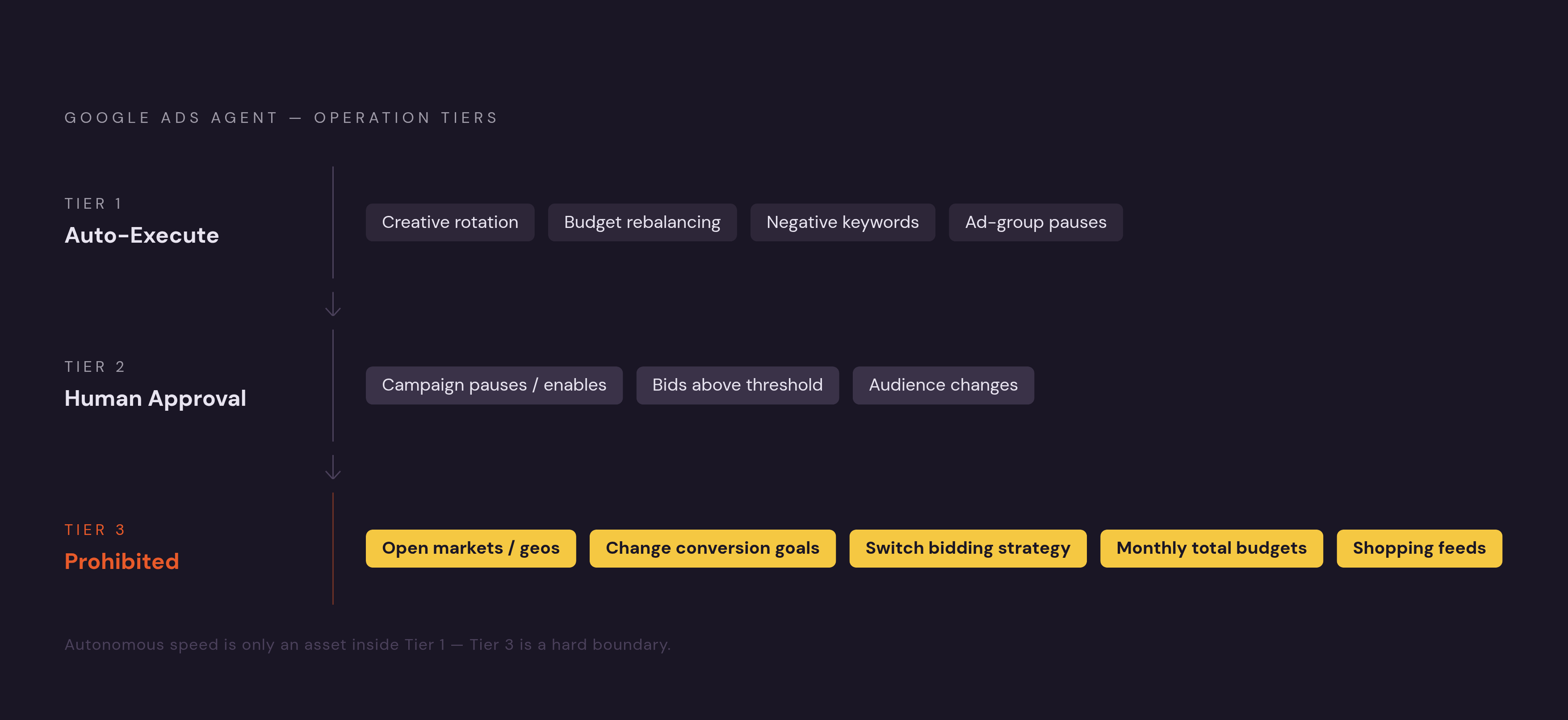
The first design task is to classify operations before writing agent code. Keep routine, reversible work in the auto-execute tier, including creative rotation based on fatigue and CTR, capped budget rebalancing on marginal ROAS signals, and negative keywords drawn from a vetted list. Ad-group pauses can qualify when CPA exceeds a defined threshold for a defined window, such as three consecutive days. Slack anomaly alerts also belong here as observations of the account.
Campaign pauses deserve a different level of scrutiny. Require explicit human approval for them, for bid or budget changes above the agreed percentage threshold, and for adding or removing audiences. These actions can affect brand defense or a funnel stage even when the numbers look reasonable. Reversibility alone is not enough to justify automatic execution.
Keep all strategic decisions out of the agent’s scope. Those include opening markets or geographies, changing conversion goals, switching bidding strategies, setting monthly total budgets, and selecting Shopping feeds or catalogs. The agent does the frequent work while a human buyer makes decisions whose effects last beyond a campaign cycle.
Bid floors, ceilings, and percentage caps as the numerical spine of the guardrails
Operation tiers define which actions are possible. Absolute bid floors and ceilings, a per-operation percentage cap, and a cumulative cap across a rolling week should be based on the account’s historical volatility. A single-run cap can truncate a proposed budget doubling, but it cannot prevent repeated small increases from drifting too far. The weekly cap closes that gap.
Absolute limits apply regardless of percentage calculations. A floor keeps bids from falling to zero, which would stop distribution in practice without an explicit pause event. An upper bound constrains runaway increases, particularly given Google’s overdelivery policy. These are hard controls. They must hold even when every alert is ignored.
Smart Bidding also needs enough conversion data before it is turned on. Google’s guidance points to a minimum conversion volume over a recent rolling window, so the relevant threshold belongs in the rollout criteria. Below that level, manual or rule-based bidding is the better starting point. An agent cannot make up for a lack of signal, which matters for startups and growth-stage brands that want to get more work done with the resources they have.
Dry-run validation, read-after-write verification, and why both steps are required
Before a live mutation, send the request through the Google Ads API’s validate_only option. It validates without executing and returns errors for problems such as malformed requests, invalid field values, and policy violations. The official server uses a two-step pattern for assets and labels. Teams that use third-party servers or the raw API need to build that protection themselves. A request can pass validation and still fail when it runs.
After each write, read the changed object back. Return the persisted state to verify the payload sent to Google. The API can accept fields left out of the field mask, report success, and change nothing, so a successful response alone is not enough. Comparing the saved state with the intended change exposes silent failures and prevents false success records.
There is also a check before the write. Read the current value immediately before mutation and include it in the proposal. Otherwise, a human’s intervening budget edit can be overwritten by a stale plan. These checks answer different questions about validity, freshness, and persistence.
Scoped permissions and account-role configuration as the access layer
Account permissions constrain what server code can actually do. A Google Ads Read-only role can view campaigns and reports but cannot edit campaigns, so write attempts fail at the API level. Standard is the minimum role for a write-capable agent and should cover only the intended sub-accounts. Admin also permits account-access and billing management. Do not grant it unless those functions are explicitly part of the agent’s remit.
An agent connected through a manager account, or MCC, could receive an instruction to raise bids across every accessible account. Per-account scoping limits that reach. Use separate OAuth credentials for test and production environments and for read-only audit and write-capable optimization roles. Google’s tools_config.yaml also allows tool groups to be disabled, so remove write namespaces from instances that do not need them and use time-limited access.
Approval gates and how changes reach a human
Approval is a designed control. Route proposals above the per-operation percentage cap for review before truncation, giving a human the chance to approve the full change. Campaign-level pauses or enables and first writes to a new account or campaign also require confirmation. Strategy changes stay outside what the agent is allowed to execute, even when a human reviews the recommendation. Approval should not quietly give the agent more tools to use.
Each proposal needs a freshly read before-value, the intended after-value, and the rule or signal behind the change. Send it to a review queue, with Slack as one possible delivery channel. Changes that are approved still need read-after-write verification, and when a reviewer rejects a proposal, the log needs to say why. Human approval does not replace execution checks.
An agent can check for anomalies every hour and surface a morning digest of proposed actions rather than interrupting someone for every observation. Routine operations continue automatically inside their limits. The speed cost applies only to the gated tier.
Shadow mode and the period before live write access
Run a new agent in log-only mode before allowing live changes. Record each proposed mutation with its before-state, triggering signal, and intended after-state, then compare it with human decisions and account performance over the same period. This gives the team evidence for adjusting caps. If proposals are always small, tighter limits may make sense, while proposals that cluster near the limit need review.
Shadow mode also exposes stale plans without spending money. A proposal that would overwrite a human’s same-hour edit can be examined without applying it. Running in log-only mode cannot, however, show that a live mutation would persist, so execution checks still need to be tested before rollout. Shadow mode preserves the ability to withhold action. The kill switch must preserve the ability to stop it later.
The kill switch and queryable change log as the safety net for everything above
A kill switch should be simple and accessible. A flag in a database or configuration file can make the agent exit immediately on startup and log that the run was skipped. Anyone responsible for observing the account should be able to reach it, including a media buyer who spots anomalous spend at 2am. Revoking OAuth credentials is a separate, more disruptive action. An operational pause leaves credentials and configuration intact for diagnosis.
Capture the timestamp, affected account and campaign, triggering signal, before-state, proposed after-state, human approval status, verification result, and any error. Store those records in a queryable form, with indexed account, campaign, timestamp, and action fields. An indefinitely growing flat file is not enough at incident speed.
Google’s change history records what changed, who changed it, and when, leaving the triggering rule and separate human approval to the internal record. The internal log supplies context for diagnosis and the before-state needed to plan a rollback. It also supports continuous improvement, including comparing a week of shadow proposals with outcomes to tighten or widen the guardrails.
How to sequence the full architecture from zero write access to auditable autonomous operation
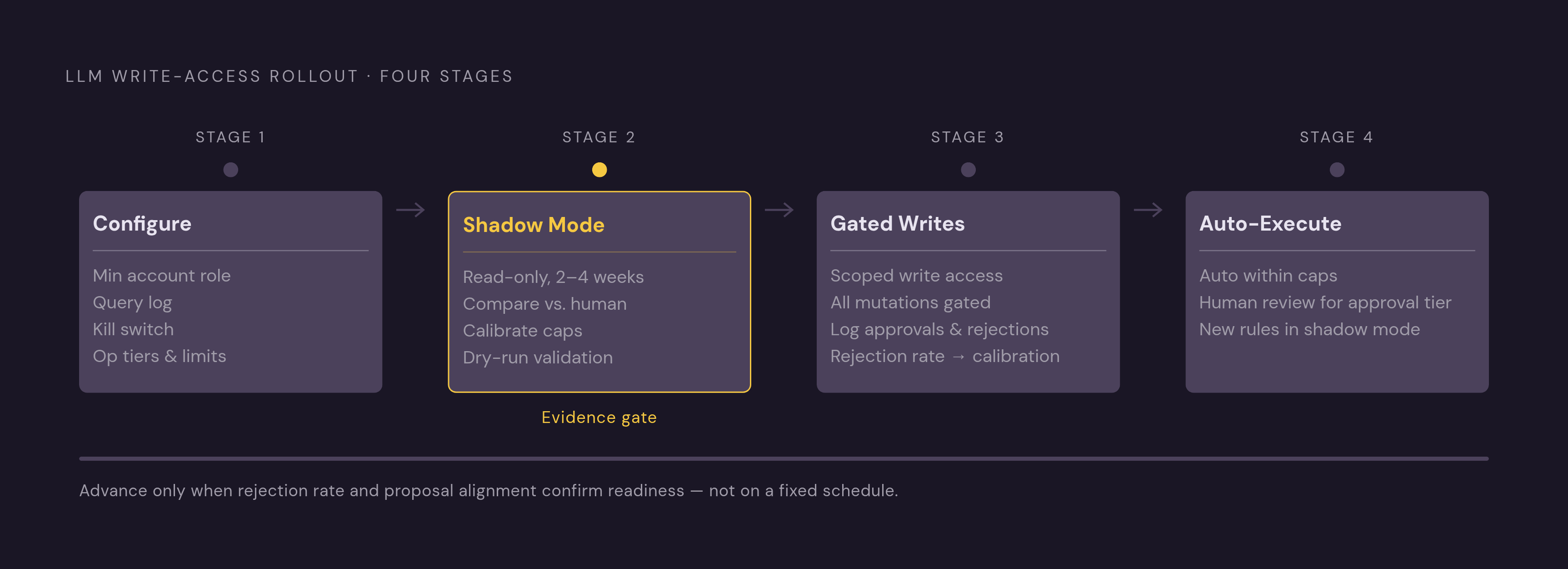
Start with the account’s operation tiers and written numerical limits. Before granting access, configure the minimum account role, build the queryable log, and implement and test the kill switch. Limits belong in enforceable controls.
Next, run read-only shadow mode for two to four weeks. Comparisons of proposals with human decisions and outcomes should guide calibration of the caps. Test dry-run validation and the verification workflow in the environment where they will run before turning on production writes. For Smart Bidding, sufficient recent conversion volume is an additional gate.
Then grant scoped write access with every mutation gated. Log approvals and rejections with reasons, and use the rejection rate to judge whether the agent’s proposals are calibrated. Graduation is a team decision based on that evidence. A calendar alone cannot establish readiness.
Finally, release only the auto-execute tier within its caps. Keep human review for the approval tier, and keep prohibited operations out of the tools the agent can use. New rules and expanded capabilities should run in shadow mode while established operations continue. These stages overlap as the system improves, rather than ending in a one-time handoff to unrestricted autonomy.
What a platform built for autonomous bid management should handle so teams don't have to build it from scratch
Building these controls on the raw API is an ongoing engineering commitment. A purpose-built platform should provide adjustable per-account limits, structured approvals, queryable logs, a non-engineer-accessible kill switch, and shadow mode for new capabilities. Slack delivery alone is not an approval system. The evaluation should also establish whether logs capture the before-state, decision context, approval status, and persisted result.
For teams spanning channels, the same architecture should cover Google, Meta, LinkedIn, Reddit, and Twitter without separate safety projects. Adside is one option for unified ad operations, with Slack integration and ChatGPT-style assistants that keep stakeholders informed about account activity. Teams can run it self-serve or hand it to expert marketers through a fully managed service, keeping the distinction between work that is automated and decisions that people make.
Custom development remains a legitimate choice for teams with engineering capacity and specialized margin or attribution data. Buying shifts responsibility for maintaining the same required controls. The decision is therefore whether the team or its platform will enforce the operating envelope and produce the evidence that it held.