Google Ads MCP Servers Ranked by Reporting Depth for Retainer Billing Justification
Compares which Google Ads MCP servers best document agency work.
Google Ads MCP servers let AI assistants query Google Ads data, and some third-party servers also let them change campaigns. For retainer billing, the best choice is the server that exposes evidence of work. Google’s official server provides deep read access, Markifact combines writes with human approval, and Improvado fits engagements where compliance documentation is part of the deliverable.
Why retainer billing creates a reporting problem that standard dashboards cannot solve
A retainer client pays for the work behind the performance chart as well as the chart itself. Campaign results can show whether an account improved, but they do not explain which search terms the agency examined, why it added negative keywords, or when it adjusted bids. Those decisions need a traceable record.
Standard Google Ads dashboards show account performance, but they do not produce a queryable, natural-language-accessible audit trail that an assistant can surface during a client call. MCP servers expose the API through tools an assistant can call, so a search term report request can be logged, replayed, and packaged as evidence of analysis. That is the billing-justification gap MCP can help close. However, the connection alone guarantees none of the necessary detail, because campaign breakdowns, conversion attribution, change history, and historical trends depend on what the server exposes.
What can Google Ads MCP servers expose, and what can they not touch?
An MCP server makes selected Google Ads API functions available as tools for an AI assistant. The protocol does not determine reporting depth. The server’s implemented tools do. Two products described as “connected to Google Ads” can give an agency very different views of the same account. A connection that returns account totals is not equivalent to one that can query search term spend or conversion actions by campaign and ad group.
Google’s official server has a search tool that uses Google Ads Query Language, or GAQL, and separate tools for account discovery and resource metadata. It can examine campaigns, keywords, search terms, conversion actions, and other resources. Its read-only tool set cannot create campaigns, adjust bids, pause campaigns, upload offline conversions, or manage audiences. Those actions require API write capabilities that the official MCP tools do not expose.
That boundary separates observing work from performing it. A read-only server can report changes made elsewhere, while a write-capable server can participate in the action itself. For billing, useful artifacts include search term performance with spend attribution, conversion breakdowns, dated change history, and cost or ROAS trends over comparable periods.
The five dimensions that separate shallow from deep reporting for billing purposes
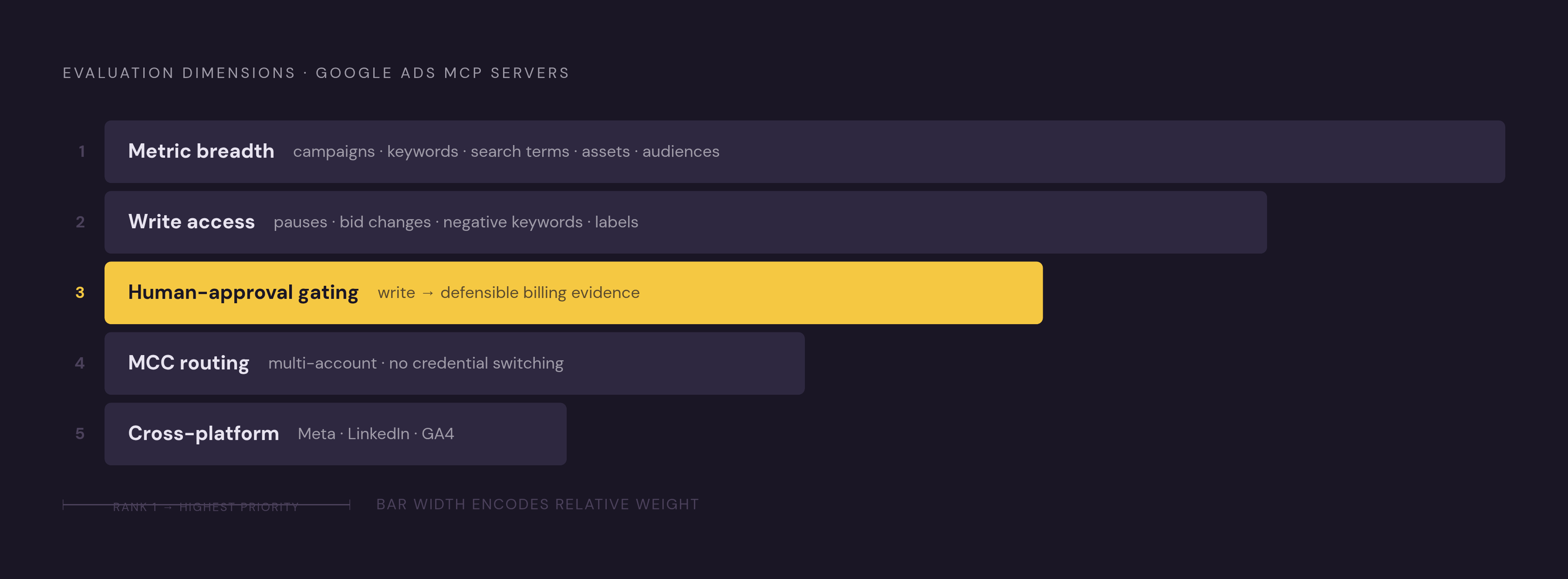
The first dimension is breadth of queryable metrics, covering campaign, ad group, keyword, search term, asset, audience, and conversion data. The second is write access that enables work evidence, including pauses, bid changes, negative keywords, and labels. Observation and execution answer different client questions.
The third dimension is human-approval gating on every write. An explicit confirmation protects spend and documents that a person reviewed the proposed action. The fourth is multi-account and MCC routing, because manual switching between client credentials eats into the efficiency assumed by a retainer. The fifth is cross-platform coverage, enabling an assistant to combine Google Ads, Meta, LinkedIn, and GA4 data without a separate tool chain.
These dimensions form a scope-based scorecard. A reporting-only engagement has no need for campaign edits, while a full-management engagement needs more than broad read access. Compliance-heavy engagements also place greater weight on the records surrounding access and execution. The strongest option is therefore the one that produces the evidence promised in the contract.
Google’s official MCP server offers strong read depth but limited billing evidence
Google’s official server queries 181 resource types through GAQL, including campaigns, search term views, conversion actions, asset performance, and change history. Its read breadth is substantial. Technical teams can use that range to investigate account performance and report on changes without giving the assistant permission to execute them. For a read-only audit mandate, that is a legitimate fit.
The setup is less straightforward for nontechnical agencies. It requires a Google Cloud project, OAuth credentials, self-hosting, and GAQL knowledge to move beyond surface-level aggregates. Google ended developer-token authentication on September 9, 2026, and moved access to the Cloud project.
The documentation and project overview disagree on write status, so the read-only tools described here should not be treated as proof of execution capability. The server can find multiple accounts through list_accessible_customers, but staff still have to handle manager-account hierarchy routing by hand. There is no cross-platform coverage. The server is free and open source under Apache 2.0, but the agency still pays to host and maintain it.
Markifact offers the deepest write-plus-approval combination for billing documentation
Every change is proposed, reviewed, and confirmed by a human operator, creating a timestamped record of decisions during the retainer period. Approval is part of the deliverable.
Its hosted setup uses one-click OAuth and automatic manager-account routing, reducing the need to reconfigure credentials across clients. It covers 50-plus platforms, including GA4 and Google Tag Manager, so reports can draw on more than Google Ads in the same session. The MCP has ten top-level tools and loads operations as they are needed. That helps it use the context-window well even when reporting sessions run long.
Together, these features make Markifact the best fit here for records that support full-management billing and show both action and human review. It does not make usage costs disappear. Pro costs $79/month, Team pricing is higher, and usage-based credits apply to workflow runs and AI agent interactions. The cost of that evidence depends on how complex the accounts are and how many there are.
Improvado fits when compliance documentation is itself the billing proof
For agencies serving healthcare, financial services, or other regulated clients, documentation around compliant handling can itself be a contracted deliverable. Performance figures alone cannot satisfy that obligation.
The MCP Only plan is metered through weekly MCP actions, while Growth and Enterprise unlock the compliance features relevant to this use case. The plan boundary is important. Access to an MCP connection should not be confused with access to the compliance infrastructure the client requires. Audit trails, data residency, and healthcare data-handling agreements are the kinds of requirements that define these engagements, rather than extras to consider after choosing a connector.
Improvado documents write access, with pausing ad sets given as an example, but does not publish approval-gating details. Agencies should verify that behavior before treating it as a write-with-audit tool.
Supermetrics, Windsor.ai, and InsightfulPipe trade cross-channel coverage against approval-gating gaps
Supermetrics, Windsor.ai, and another cross-channel reporting vendor can report across channels that the official Google Ads server does not cover. That breadth serves a clear billing purpose. An agency responsible for several channels needs to explain their combined contribution.
Windsor.ai covers 350-plus sources and has documentation on write actions for several connectors. Unresolved approval controls and per-action limits for those writes leave a risk that an unapproved change could damage the client relationship. Connector breadth is not evidence of review controls.
Supermetrics and Windsor.ai have documentation for their connectors to LinkedIn Ads data, while the third vendor is part of the wider cross-channel comparison. As of November 2, 2026, no official LinkedIn MCP server was found. The available detail does not establish equivalent approval controls across these options, so a finer ranking would imply more certainty than the evidence supports. They help support bills by covering more channels, but agencies still need to check write permissions and how changes are confirmed before using them on live accounts.
Read-only options fit reporting mandates and stop at execution
Coupler.io, GoMarble, and the cohnen fork belong in the read-only discussion, where execution is outside the engagement’s scope. Read-only is not a lower grade of service. For an analyst or reporting retainer, it prevents an assistant from turning a recommendation into an account change. That boundary can be exactly what the client bought.
Coupler.io covers 400-plus data sources and has a free tier and a low starting price for paid use. Coupler.io’s documentation states that queries are read-only and that the AI cannot edit, delete, or overwrite imported rows. Its fit is low-risk reporting and data extraction without a write surface. The breadth of sources does not change that permission boundary.
GoMarble is open source, permissively licensed, self-hosted, and read-only, with local Google Cloud project setup required. It fits technical teams that build their own reporting pipelines on infrastructure the agency controls. The cohnen community fork has a separate upkeep issue because it calls a deprecated API version. That issue distinguishes permission safety from software upkeep.
How to match MCP server depth to retainer scope across a client portfolio
Agencies should choose a permission architecture. A reporting-only client should have a read-only connection even when the selected product supports writes. The product’s maximum reach is irrelevant if the engagement excludes execution. The access boundary itself documents the scope of the relationship.
A full-management client needs write access that has human-approval gating. Approved changes recorded by client, week, and campaign provide a defensible account of work performed. At portfolio scale, MCC routing also affects the economics, because repeated credential switching consumes time the retainer price assumes will be available for client work.
Channel scope should guide the remaining choice. A mandate covering Google Ads, LinkedIn, and Meta calls for reporting that can explain the combined work without three separate MCP sessions. Markifact fits the approved-execution case, the official server fits technical read-only analysis, and Improvado fits compliance-led engagements with its gating question resolved.
The approval-gating and policy risks agencies must resolve before connecting any server to a live account
Before live-account use, agencies should resolve human approval and policy-compliant hosting as preconditions. A server’s documented write capability must be distinguished from documented confirmation behavior, and a compliance requirement must be matched to the plan that supplies it. Without those checks, the tool can do more than the client allowed.
Access quotas also constrain delivery promises. As of September 9, 2026, new Google Cloud projects enter at Test access, while a higher access tier is available by application and permits 2,880 operations per day on live accounts. That supports reporting workflows but not high-frequency optimization loops or high-volume automated audits. Agencies planning automated audit schedules should verify their project’s access tier before promising a reporting cadence.
Usage metering creates another constraint on retainer margins. Maintenance needs the same continuing scrutiny. The cohnen fork’s deprecated API version shows why agencies need to keep checking that the API is current and revisit their choice of server after setup.