When an AI-Managed Meta Ad Service Beats a Human Agency
AI agents outperform human teams when spend volume, creative velocity, and optimization speed align.
AI-managed Meta ad services have stopped being a marketing label. They are now autonomous systems that read performance data, make decisions, and write changes back to the Meta Marketing API without a human touching the dashboard. This distinction is not cosmetic. A rule-based scheduler fires when CPA crosses a threshold regardless of why it crossed. An agent checks whether the ad set sits in a learning phase, whether creative fatigue explains the spike, or whether a low-intent day skewed the numbers. Context plus metrics, not metrics alone.
Production-grade implementations share three capability layers. A read layer ingests campaign, creative, and audience signals from the Marketing API. A decide layer runs a logic engine that applies conditions rather than raw thresholds. A write layer handles API execution with scope confirmation before any change goes live. Ad Library's 2026 guide lays out this architecture, and every serious tool in the space follows some version of it.
Meta's own infrastructure is moving in the same direction. The Ranking Engineer Agent, published March 17 by Meta's engineering team, is an autonomous system that doubled average model accuracy over baseline approaches across six production ads ranking models. Those models decide which ads win auctions. REA ran multi-week experiments with human oversight only at key strategic decision points. The system that allocates ad inventory is now partly self-improving.
MCP has lowered the technical floor for third-party access. Meta shipped a read/write MCP server on April 29, 2026, paused by default. The protocol is conversational. It responds when asked rather than monitoring in the background. But it makes AI assistants capable of managing campaigns through conversation instead of manual Ads Manager clicks. That is a structural change, not an incremental one. The competitive landscape between AI services and human agencies shifted because the access layer itself got formalized.
The structural conditions where human agency workflows hit their ceiling
Human agency workflows have a hard ceiling under three specific operating conditions. These are not general indictments of agencies. They are structural constraints that appear when signal volume exceeds human processing speed, when creative velocity requirements outpace human production capacity, and when optimization cycles demand changes faster than weekly check-ins allow. None of these conditions exists in every account. When all three appear together, manual management stops being a preference issue and becomes a physics problem.
Signal volume is the first constraint. Meta's platform generates auction and behavioral signals continuously. A human media buyer context-switching across accounts cannot monitor and respond at the granularity an API-connected agent can. The agent catches CPA trends hours before a human notices manually. This is not a skill gap. It is a throughput limit. A well-trained buyer with a high-conviction process still sleeps, still takes meetings, and still handles multiple clients.
Creative velocity compounds the problem. Top DTC brands operate at a creative velocity of 1.5 to 3.0, meaning 15 to 30 new creatives per week per unit of spend. A pace like that exceeds what human production teams can sustain without AI assistance. One supplement brand moved from 8 new creatives per week with a human-only process to 35 per week with AI assistance. Individual ad performance did not improve. Winners were found substantially faster because testing volume was dramatically higher. Volume itself became the discovery mechanism.
Optimization cycles add the final pressure. Rule-based automation has existed since 2016. Pausing when CPA exceeds a threshold handles obvious cases. It fails when context matters, and context always matters on Meta. Agent-layer logic resolves this, but it requires giving up human control of intra-day decisions. The Advantage+ system already outperforms manually managed campaigns on ROAS. Lead generation campaigns using it report lower cost per lead than traditional setup. The pattern is consistent. Where speed of decision compounds, automated systems pull ahead.
Where AI-managed services demonstrably win: signal-rich, high-velocity, budget-iterative scenarios
AI-managed Meta ad services produce their strongest advantage when three conditions appear together. Sufficient conversion signal volume gives the algorithm enough spend to learn. High creative throughput requirements demand more variants than a human team can ship. Budgets that justify continuous intra-day optimization reward frequent adjustments. Remove any one condition and the edge weakens. Stack all three and the gap becomes structural rather than tactical.
The budget floor matters first. Below a meaningful monthly Meta spend threshold, the optimization surface is too small for agent logic to reliably outperform attentive manual management. A human who knows the account can cover the same ground. Above that threshold, continuous agent optimization compounds daily. Small intra-day shifts add up across a month in ways a weekly review cadence cannot replicate. The higher the spend, the more each hour of delay costs.
Creative volume is the primary lever. Meta's Andromeda system made creative diversity and volume the main performance input. The advertiser who feeds the algorithm more variants, faster, wins more auctions. This is a structural machine advantage, not a marginal one. AI-generated ads achieve higher average CTR than human-created ads across large-scale benchmarks, and lower average CPA. The edge holds specifically at lower AOV price points, which matters for the decision framework later. For products where click-driven conversion dominates, the machine wins.
The clearest case comes from NuYu MediSpa. Their previous agency produced roughly 4 ad creatives per month with 3-week campaign launch cycles. An AI-first approach generated 30+ creative variations in the first week and went live within days of kickoff. Lead generation increased 2,415% with a documented surge in bookings. That is not a marginal improvement. It is what happens when creative throughput stops being the bottleneck.
The intelligence gap closes where rule-based tools cannot follow. An agent can cross-reference competitor creative patterns in-market before proposing a swap. It responds to competitive context in real time, not just internal metrics. This layer of reasoning is what separates agentic management from the automated rules advertisers have had since 2016. Condition-based logic applies judgment to thresholds. Competitor-aware logic applies market context to both.
Where the human agency still has a genuine structural advantage
The AI advantage does not hold across all products, all creative demands, or all account types. Human agency judgment outperforms AI-managed services when creative is the bottleneck and purchase decisions require trust signals AI cannot yet replicate. This is not a retreat from the thesis. It is the calibration that makes the thesis usable. The conditions where agencies win are identifiable and specific.
The AOV threshold is the clearest dividing line. AI creative produces a ROAS advantage over human creative for low-AOV products. Human-directed creative holds an increasing edge above that threshold, widening further for higher-ticket products. Premium purchase decisions involve trust signals. Brand storytelling, lifestyle aspiration, and production quality are things current AI tools produce inconsistently. AI creative excels at pattern-matching visual hooks that drive clicks. It lacks the emotional intelligence required to convert considered purchases. The click is not the conversion.
This gap shows up in practice. A Foxwell 2026 survey found that only a small fraction of agency leaders have produced a top-performing AI-generated ad. When creative is the constraint, when narrative and brand voice carry the weight, agent automation of bidding and targeting does not compensate. The execution layer gets optimized while the message stays weak. That is not a win. It is a faster path to a losing ad.
Autonomous MCP execution carries a specific operational risk worth naming. The protocol is conversational. It responds when asked. It does not monitor in the background. A model error connected to a live ad account with write access can change budgets, pause campaigns, or create ad sets with incorrect settings before a human catches it. Scope ambiguity is the most dangerous design pattern. The right guardrails matter, and the conditions where high-AOV, trust-dependent creative dominates are also where errors cost the most. This makes the decision framework in the next section load-bearing.
How to identify which side of the line your account sits on
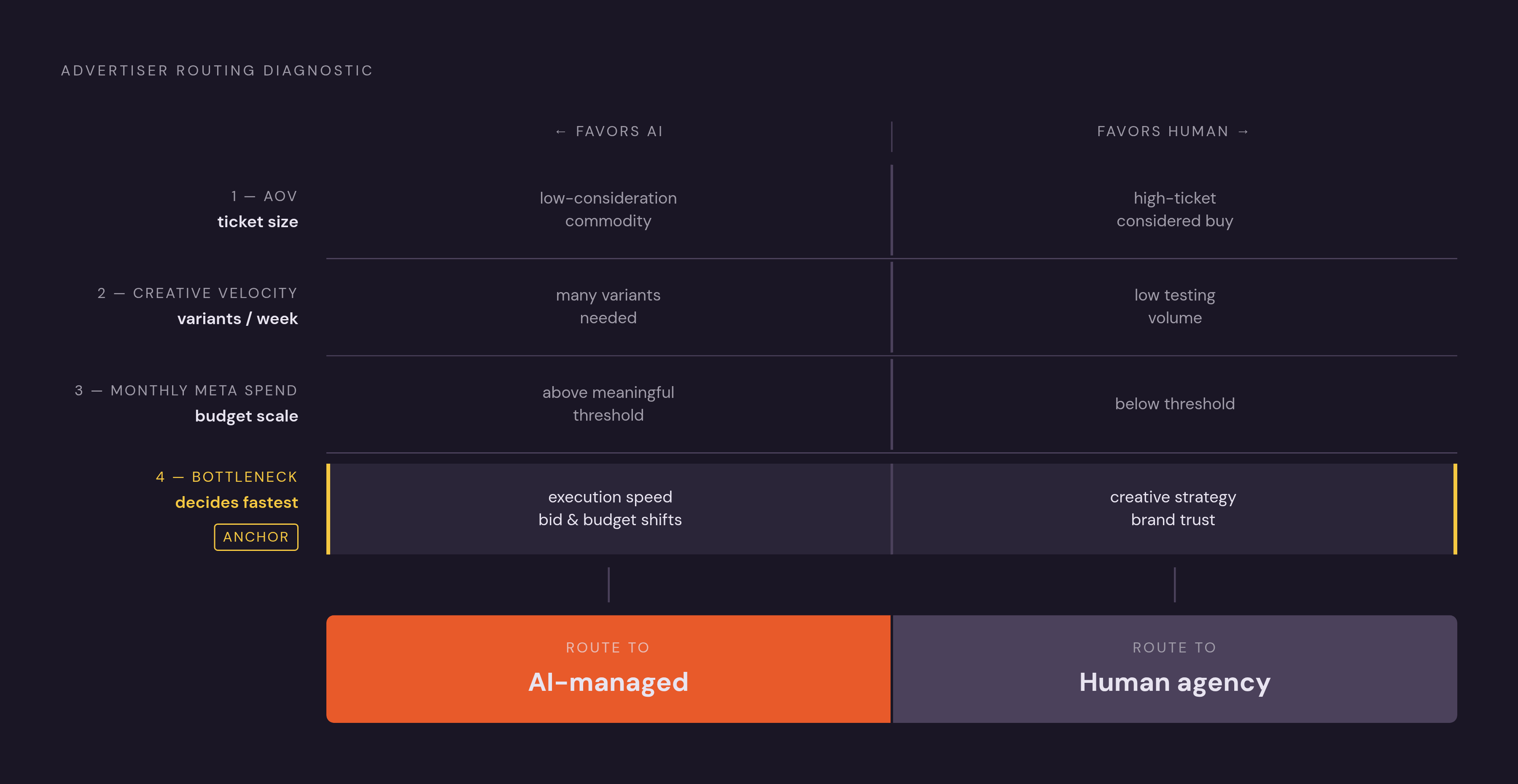
The choice between AI-managed services and a human agency comes down to four account-level variables. AOV, required creative volume, monthly Meta spend, and whether the primary bottleneck is optimization speed or creative judgment. Audit each one honestly and the answer usually becomes obvious. Skip any of them and the decision gets made on vibes instead of structure.
Variable one is AOV and product complexity. Below a roughly low-AOV, lower-consideration purchase threshold, AI-managed creative and optimization holds the measurable performance edge. Above that point, especially for higher-ticket products, weight toward human-directed creative even if automation handles bidding and targeting. The split is not all or nothing. Plenty of accounts benefit from AI on execution and humans on message.
Variable two is creative velocity requirement. If the account needs to test many creative variants per week to find winners at its spend level, AI-managed services have a structural throughput advantage. A human team cannot match that pace without AI assistance anyway, so the question becomes whether anyone is even performing the function. High-velocity testing demands infrastructure. AI provides it.
Variable three is monthly Meta spend. Below a meaningful monthly threshold, the conversion signal volume is insufficient for agent-layer optimization to reliably outperform attentive manual management. The practical optimization surface is too small. Above that threshold, continuous agent optimization compounds daily. Spend level determines whether the agent has enough data to learn from.
Variable four is bottleneck diagnosis. If the primary constraint is execution speed like intra-day budget shifts, creative rotation, or bid adjustments, AI wins. If the primary constraint is upstream creative strategy, narrative, or brand trust, human judgment remains load-bearing and cannot be automated away. This variable often decides the whole question faster than the other three. Name the bottleneck and the answer follows.
Cost structure works as a secondary signal. Fully managed AI ad services typically run meaningfully less than traditional agency retainer costs on production-heavy work for mid-market engagements. The gap narrows or disappears on strategy-led work. Traditional mid-market retainers run $15,000 to $50,000 per month. AI agency retainers run $2,000 to $8,000 per month. The cost advantage is real on volume and execution work, roughly neutral on strategic work, and negative whenever judgment is the primary deliverable. For advertisers running across multiple channels like Google, Meta, LinkedIn, Reddit, and Twitter, a unified AI platform handling competitor ad tracking, creative analytics, and campaign operations in one interface removes coordination overhead. That overhead otherwise forces a choice between fragmented tools and an agency retainer.
What the next 12 months change about this calculation
The conditions that define where AI-managed services win are narrowing the agency-advantage zone. The gap between early-adopter results and average-brand results means the shift is not yet uniform. But the direction is clear, and the variables worth re-auditing are already visible.
Meta's goal-only automation is in testing now and expected to reach broader availability later in 2026. URL plus budget as the only inputs. If it delivers at scale, the execution layer of agency work becomes fully automatable at the platform level. Creative upload, targeting setup, and bid management stop being services anyone pays for separately. They become settings.
REA is continuously improving the ad auction algorithms with minimal human intervention. The underlying system AI-managed services optimize against is getting more capable quarter over quarter. Campaigns structured to feed it signal like broad targeting, high creative volume, and conversion-event clarity compound this advantage over time. Advertisers who structure for the algorithm now benefit from every future improvement to it.
The MCP infrastructure formalized in 2026 changes the access question permanently. Meta shipped April 29, Google on April 28, TikTok on May 13. Multi-channel agentic management from a single conversational interface is no longer experimental. It is available to any team with the right platform and the right guardrails.
McKinsey's April 2026 research adds a useful grounding note. Nearly two-thirds of enterprises worldwide have experimented with AI agents, but fewer than 10 percent have scaled them to deliver tangible value. The early-adopter results documented here are real but not yet average. That gap is large enough to be a competitive advantage for brands that move now. The framework stays the same. AOV, creative velocity, spend level, and bottleneck diagnosis. Re-audit those variables as the platform evolves, because the line between what machines and humans do best will keep moving. Knowing which side of it your account sits on is the decision.