Meta Ad Agency Pricing Benchmarks by Startup Stage
Growth-stage startups pay vastly different fees based on spend level and pricing model chosen.

- Written by
- Darius OkaforAgency Economics Editor
- Published
- October 10, 2026
- Reading time
- 11 min read
What this covers
What a Meta ads agency costs has far less to do with the agency's name than with three things: where the startup sits in its growth journey, how much it plans to spend on media each month, and which pricing model it accepts before signing. Two structural pricing systems dominate the market, and depending on how much you spend, they produce wildly different outcomes. The first is percentage-of-spend, where the agency takes a cut of whatever moves through the ad account. The second is a flat monthly retainer, where the fee stays fixed regardless of how much media budget flows through it. Neither structure is wrong on its own. The mistake founders make is applying the wrong model to the wrong stage, paying percentage fees on a budget too small to justify them, or locking into a flat retainer that can't flex when spend suddenly triples. A newer option has also entered the market: AI-native flat-fee platforms that hold the same price no matter how much media spend runs through them, which gives founders a new reference point for judging whether a traditional agency quote makes sense.
What percentage-of-spend pricing costs at each spend level
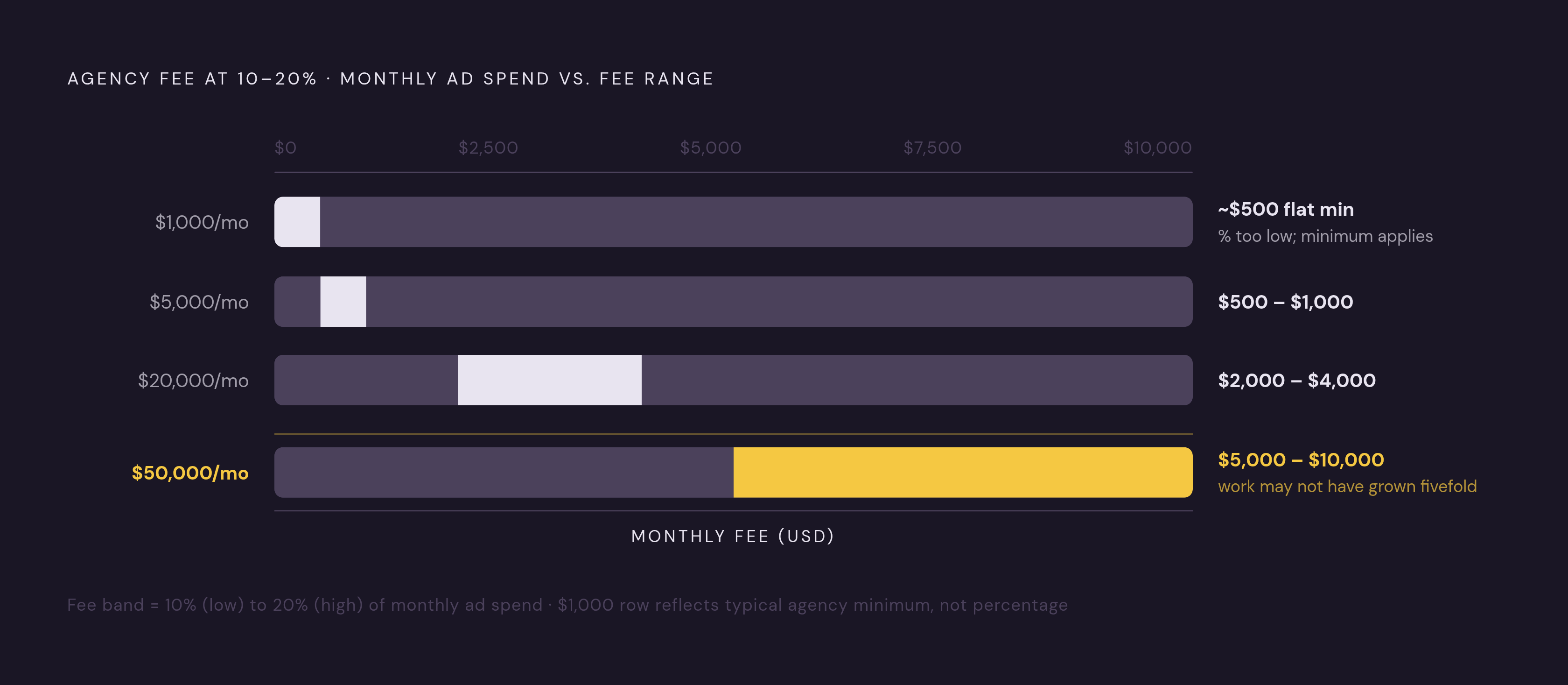
Percentage-of-spend pricing runs 10% to 20% of monthly media spend, but the arithmetic looks very different depending on how much you spend. At $1,000 a month in ad spend, the fee works out to $100 to $200, which sits below the floor almost any agency can actually operate on. In practice, this means the quoted percentage gets replaced by a flat minimum instead, so the founder ends up paying more than the percentage math would suggest. At $5,000 a month, the fee is $500 to $1,000 on top of spend. At $20,000 a month, it climbs to $2,000 to $4,000. At $50,000 a month, the fee reaches $5,000 to $10,000, with no guarantee that the strategic workload actually grew fivefold to match. That last point is where percentage pricing starts to punish growth: a startup that scales its media budget five times over pays five times the management fee, even though campaign structure, audience targeting, and reporting cadence rarely scale at the same rate. Some agencies will cap the percentage past a certain spend threshold or blend it with a flat base fee, but that has to be negotiated into the contract before signing, not assumed. Two costs sit outside this calculation. The management fee is always separate from the media spend itself: the ad budget goes straight to Meta and never counts toward what the agency charges. Creative production, meanwhile, is typically excluded from both percentage and flat retainer fees, so video, UGC, and design work get billed separately or left for the client to produce.
Retainer tiers: what they include, where the gaps appear
A fee only means something next to the deliverables attached to it, and the scope document, not the sales pitch, is what actually defines those deliverables. Standard retainer scope typically covers campaign strategy and setup, audience targeting, budget and bid management, creative rotation, and reporting on a weekly or monthly basis. Notice the word rotation there, not creation: most retainers assume the client already has finished creative assets and the agency simply rotates them in and out as performance dips. That assumption is the highest-stakes gap in the entire pricing conversation, because performance on Meta is driven overwhelmingly by creative quality. When assets fatigue and no one on the agency side is producing new ones, the account is exposed with no one accountable for fixing it. Landing page work, tracking repairs, and attribution setup also fall outside the scope, so you need to negotiate or budget for them on their own. Service depth generally scales with the price tier paid. Entry-tier retainers staff junior account managers who only execute, so they work if you already have simple funnels and creative in hand. Mid-tier retainers bring a more experienced team and room for real strategic dialogue, so they fit brands that are ready to scale past their first few campaigns. Upper-tier retainers bring senior strategists, direct creative involvement, and proactive testing frameworks for ongoing optimization. A handful of red flags signal poor value no matter what tier is quoted: guaranteed ROAS promises, vague deliverables lists, long contract lock-ins, and any agency that insists on owning the ad account rather than running it under the client's own ownership. That last point deserves particular weight, because an agency that owns the account controls the historical data, the pixel, and the ability to walk away with the relationship intact if the engagement ends badly. Once you settle the scope and ownership questions, you still need to ask which tier fits which stage of the company.
Pre-seed and bootstrapped: when agency fees eat the budget before the ads run
Before a startup finds product-market fit, the goal of running Meta ads is to learn what works, not to scale what already does, and that changes what paid support is actually worth. At very low monthly spend, a percentage-of-spend agency fee exceeds what the account can even generate in useful data. Full agency management is structurally the wrong fit at this stage, regardless of how good the agency is. Somewhere between $2,000 and $5,000 a month in spend, a hybrid model starts to make sense: the founder handles creative direction and approval directly, while a freelancer or lightweight agency builds campaign structure, sets up audiences, and manages optimization. Freelancer pricing on platforms like Upwork runs $15 to $40 an hour for Meta ads work, with a median around $25, so it costs far less to get into than any agency retainer minimum. AI-native flat-fee platforms also enter the picture at this stage as a legitimate option: tools that automate campaign creation, ad copy, and creative production for a flat monthly fee let a pre-seed founder run structured tests without carrying agency overhead. What matters about any paid support at this stage is whether it helps the founder learn faster, or whether it just manages execution the founder could run directly.
Seed to Series A: what a growth-focused retainer buys at this stage
Once a channel has proven itself and spend is climbing, the cost of poor management, meaning missed optimizations, stale creative left running too long, slow testing cycles, starts to outweigh the cost of paying an agency to manage it properly. That's the inflection point where a retainer starts earning its price. Seed-stage Meta ad budgets typically fall in a range where flat-retainer or hybrid pricing makes more sense than pure percentage fees, because the fee stays predictable even if spend fluctuates while experiments run. Several agencies publish pricing that anchors this tier. Hawke Media offers retainers starting at $2,500 a month, with an a la carte model suited to early-stage companies that want flexibility without a full retainer commitment, and a recommended minimum ad spend of $2,000 a month. YourGrowthPartner starts retainers at $3,000 a month with the same $2,000 minimum spend recommendation, running a full-funnel approach across Meta and Google together. Voy Media charges a flat monthly fee starting at $3,000, plus a percentage of spend above a set threshold, with a focus on DTC e-commerce brands. Sociallyin's retainers start at $5,000 a month and include creative production, so they fit you if you want organic and paid social managed under one roof. What a founder is actually buying at this tier is a structured testing cadence, audience expansion beyond whatever the founding team's gut instinct has already tried, and someone accountable for keeping creative fresh, not just access to Meta's ad platform. Since creative production usually sits outside the retainer fee, the scope document needs to spell out how many new creative assets get produced each month and who's responsible for producing them. As companies move past Series A with a validated channel, the junior-account-manager tier that worked fine at seed often becomes the wrong fit, so they need to move toward higher retainer tiers with more experienced, more proactive teams.
Series A to C: when the pricing model itself becomes a strategic decision
At Series A through C, a startup scaling spend aggressively faces a different kind of risk: the pricing model chosen can align the agency's incentives with the company's growth or work against it. Percentage pricing, which felt reasonable at $5,000 a month, becomes expensive once spend reaches six figures, so raise flat retainers or hybrid models with negotiated spend caps explicitly in the sales process. Performance-based pricing tied to CPA or ROAS targets sounds appealing on paper, but it rarely works that way in practice, so you need real caution. If an agency gets paid against a performance target, it has an incentive to avoid testing that temporarily dents short-term numbers, or to optimize toward metrics that look good in a report without actually driving profit. A handful of named agencies anchor pricing expectations at this tier. KlientBoost typically runs percentage-of-spend pricing with management fee minimums around $5,000 a month, and it works well if you run SaaS or lead-gen and need Meta alongside paid search. Another named agency charges 10% to 15% of ad spend with similar $5,000 monthly minimums, built around strong A/B testing methodology and integrated conversion rate optimization. MuteSix runs percentage-of-spend pricing with effective minimums around $20,000 a month, and it's built for creative-led D2C brands that need high volumes of new assets to scale. Refine Labs targets Series B and later companies with $50 million or more in annual recurring revenue, with a research and planning assessment starting at $35,000 for six weeks, aimed at companies where measurement science and pipeline attribution is the problem to solve. For founders at this stage, you can't just compare agency versus agency. It's agency versus building an in-house media function: at this spend level, the fully loaded cost of a senior in-house hire starts to look comparable to an agency retainer, and the tradeoff is control and institutional knowledge against the breadth of experience an agency brings from working across many accounts. Multi-channel complexity also pushes pricing up at this stage, because an agency coordinating Meta alongside LinkedIn, Google, and Reddit does genuinely more reporting and coordination work than one that manages Meta alone.
How platform cost differences shape multi-channel agency pricing
Higher fees for multi-channel programs aren't agencies padding the bill. CPCs, CPMs, and the operational complexity of running campaigns genuinely differ across platforms, and understanding that gap lets you judge a multi-channel proposal on its substance. LinkedIn is the most expensive platform in the comparison, with CPMs of $30 to $60 and CPCs of $5 to $12, but also the most direct route to B2B decision-makers who are hard to reach anywhere else. X, formerly Twitter, runs US CPMs of $5 to $9 for broad audiences and $8 to $15 for B2B or more targeted campaigns, and remains relevant for developer, crypto, media, and political audiences even though it weakened as a general-purpose ad platform after 2023. These cost differentials matter directly to agency pricing because if an agency manages a channel with $40 CPCs, it does fundamentally different work, with tighter margins for error, than one managing a channel where test budgets stretch further. But running multiple channels through multiple agencies costs you more than just the sum of their individual fees. Splitting Meta, LinkedIn, and Google across three separate agencies creates reporting gaps, attribution conflicts between platforms claiming credit for the same conversion, and coordination overhead that chips away at the value each individual agency is supposed to deliver.
Competitor ad tracking and market research: what belongs in the stack at each stage
Most of what startups pay for in competitive ad intelligence is already free, and paid tools only earn their cost when they close specific gaps the free stack can't close. The free stack can't give you keyword-level spend intelligence, a searchable database of competitor creative across platforms, publisher-level display intelligence, or real-time sentiment monitoring that catches when customers are talking about switching away from a competitor. Meta's own Ad Library is a free, official tool for browsing any advertiser's live creative, and it's distinct from paid competitive intelligence platforms that carry similar-sounding names but sell deeper spend and targeting data. At the enterprise tier, running $1,000 a month or more, tools like Pathmatics and Adbeat add publisher-level display intelligence that the free tools don't offer, which only becomes worth paying for once a company's ad spend and competitive set are large enough to justify that level of granularity. For most startups, the right move is starting with the free stack and only adding paid tools once a specific, named gap appears that the free tools can't close.
Evaluating whether a Meta ads agency quote is worth what it costs
When an agency quote lands in the inbox, don't just ask whether the headline fee looks low. It's whether the pricing model, the scope, and the incentive structure actually match what the startup needs at its current stage. At pre-seed or low spend, check whether the quoted fee is really a flat minimum that exceeds the media budget itself, because if it is, the agency model is the wrong fit at this stage no matter how strong the agency's track record looks. At seed through Series A, the scope document needs to spell out test cadence, how many creative assets get rotated in per month, and who owns the ad account, since vague answers to those questions at this tier are a warning sign. At Series A and beyond, check whether the percentage fee is capped or whether it scales uncapped alongside spend, because an uncapped percentage fee at high spend levels is a misalignment worth fixing in the contract before signing, not after. Beyond the pricing model, a handful of scope questions belong in every evaluation: how many new creative assets get produced each month and who produces them, who owns the ad account, what the reporting cadence looks like and what the report actually contains, whether competitive research is included or billed as an extra, and what happens to campaign history and performance data if the relationship ends. An AI-native platform or a managed service built into a unified platform can also handle execution, creative automation, and competitor tracking at a fraction of what a traditional agency retainer costs, not as a substitute for senior strategic judgment, but as a real option for the execution-heavy work that makes up most of what mid-range retainers actually deliver. The choice was never strictly agency or do-it-yourself. You get a better result if you match the pricing model to the company's current stage, then revisit that match roughly every six months as spend grows and the marketing function matures.